An inspiring day of vision, innovation and collaboration at Thor Park
Energy Mission 2025, held on 21 October at Thor Park, brought together 155 professionals from the world of energy, technology and industry. Under the headline “Strategic energy partnerships, from Watt to Wow”, one question emerged: how can companies work together to speed up the energy transition?
Sirris reviews the event with insights from Paul Peeters and comments from our members.
The power of collaboration: from watt to wow
There was a great atmosphere at Thor Park from the start. Participants from research, industry and technology united around a shared conviction: the energy transition can only succeed if we tackle it together.
The day began with a keynote speech by economist and author Prof. Koen Schoors (UGent). He presented a clear and hopeful account of Europe's energy path.
'Europe is doing the right things’, Schoors said. 'The next step will require more than technology. We must learn to collaborate across companies and sectors.'
He pointed out the need to combine the profit motive with long-term cooperation. Companies that share costs and risks will not only improve sustainability but also enhance their competitiveness.
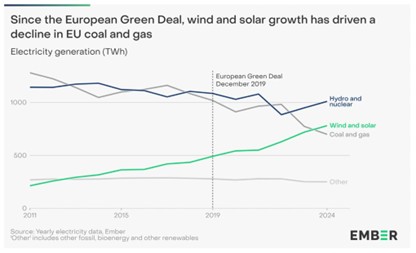
The European energy mix has been shifting rapidly towards renewable sources since the launch of the Green Deal (source: Ember).
Why cooperation is more important now than ever
The energy transition is no longer something in the future. Companies are feeling the pressure right now, from rising energy prices, limited grid capacity and tougher climate targets.
Sirris notes that more and more of its members are looking for structural solutions rather than temporary interventions. These require cooperation between companies, innovation partners and governments.
Energy Mission 2025 offered exactly that, with specific examples of how collaboration is working in practice.
Smart grid connections and shared solutions
One session with a high level of WOW content was led by Giel Valkeneers (House of Projects). He showed how shared grid connections and Battery Energy Storage Systems (BESS) applications can deal with both delays and high connection costs.
‘Smart cooperation leads to significant cost savings’, Valkeneers emphasised.
His Ostend case presentation showed how companies can work together to invest in battery capacity and infrastructure. This has come as a relief for many manufacturing companies. The solution addresses grid operator waiting times and reduces investment costs as well.
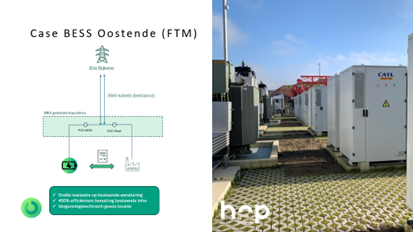
The BESS case in Ostend shows how shared grid connections lead to cost savings and faster implementation.
From insights to practice
This opens up new prospects for Sirris members. Companies working on electrification or process optimisation can use shared BESS solutions to expand their capacity without making major adaptations.
Sirris is already supporting clusters of companies that generate, store and share energy together. This case confirmed that the model works.
From measurement to management: the role of smart EMS systems
Lander Vanton (SDM-Projects) gave an inspiring session on Energy Management Systems (EMS).
‘It all starts with measurements’, he said. ‘A company cannot optimise unless it understands its energy flows.’
Standard protocols such as MQTT and OPC-UA allow digital connection of assets such as heat pumps, batteries and PV systems. This creates a flexible, future-proof energy system.
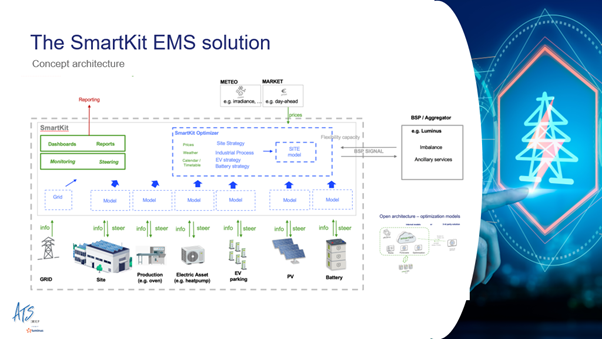
Smart EMS architecture creates digital links between energy assets and facilitates coordination between stakeholders.
A high-performance EMS architecture prevents sub-optimisation. The whole site can then be managed as a single integrated system rather than just improving components.
Companies like Citribel and Boolean showed that this pays off. Their insight: the most cost-effective battery is often the machine that is already there.
Sirris sees EMS systems as an important building block of tomorrow's smart factory.
Foresight as strength: insights from Paul Peeters
Paul Peeters, Community Manager at Sirris, shares the insights that inspired him most.
'I was very inspired by the details of the Gridual story. Their slogan “foresight = power” says it all: when you look ahead you can make energy profitable.’
KU Leuven spin-off Gridual develops models that go beyond predicting demand and price to focus on maximising profitability.
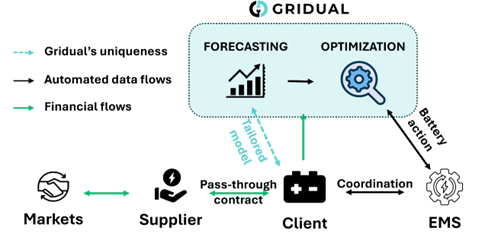
Gridual optimises profitability through predictive and value-driven energy models.
Their algorithm takes into account a company's whole context: processes, market volumes and storage capacity.
The resulting business models are based on profit sharing and data-driven decisions. This creates new opportunities for manufacturing industries to view energy as a strategic asset.
A look at the production site of the future
The main thing Peeters wanted to share with our members was the concept of PowerPulse: the Production Site of the Future.
‘This provides a clear overview of areas where manufacturing companies are already improving and areas where opportunities still exist’, says Peeters.
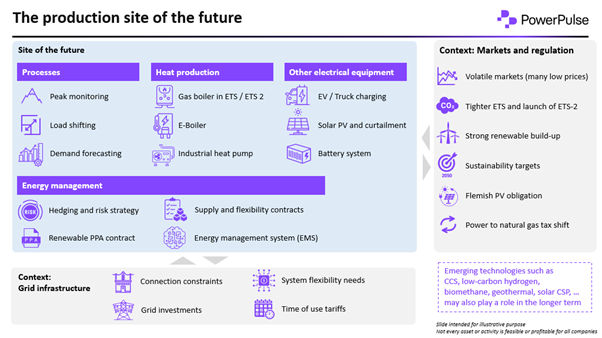
PowerPulse illustrates how the production site of the future approaches all energy processes in an integrated way.
This visual blueprint helps companies to evaluate their maturity in the area of energy management. They can see where they stand and identify their next step.
Comments from our members
The feedback from Sirris and Agoria participants was positive.
'An inspiring keynote speech, very well organised with relevant cases’, was the consensus.
‘The communication, matchmaking and networking through Conversation Starter were superb.’
People liked the combination of vision, specific cases and engaging speakers. Visitors also appreciated the practical approach.
Some of the comments yielded valuable insights. A few participants would have liked to see more problem owners from manufacturing industry. Sirris recognises this challenge and is working to solve it by getting even more manufacturing companies involved in these initiatives.
The visits to Thoreaq and ConstrucThor (the test environment at Thor park in Genk where innovative construction and renovation technologies are tested and demonstrated in real buildings, focusing on energy, air quality and smart building processes) received a very positive response. The visits showed the theory in action in tangible ways and demonstrated how working together can accelerate innovation.
Reflection: where are we going?
Energy Mission 2025 has made it clear that the energy sector is evolving towards ecosystems. No individual company is facing this situation alone. Production, storage, data and policy are all interconnected.
Sirris sees three defining trends over the coming years:
- Collective energy hubs: companies sharing infrastructure, data and energy storage
- Digital twins: simulation and optimisation of energy consumption at site level
- AI-assisted planning: smart algorithms predicting energy demand and automatically controlling production processes
Sirris helps companies to navigate a rapidly changing energy landscape by linking these trends to specific forms of support.
Conclusion
Energy Mission 2025 showed how collaboration, smart technology and vision are accelerating the energy transition. From shared grid connections to predictive models, companies discovered how partnerships can create real value. The message is clear: the future requires collaboration just as much as innovation. Companies that share data, maintain a smart orientation and work together will move faster towards sustainability. Sirris will continue to foster these forms of collaboration, acting as a guide, partner and sounding board for people who want to make energy smarter.
Want to know how Sirris can support your energy projects or digital energy control?
Contact our experts and find out how collaboration leads to impact.
Ready for your green transition?
The path to a sustainable future starts today. Get inspired by our experts and discover how technological innovations can strengthen your company within the green economy. Together, we make the difference.