Technology alone does not make a company future-proof
A digital transformation involves making many choices. What do you invest in first? What projects will strengthen your competitive position? How do you keep departments on the same page? Sirris’s Factory of the Future Serious Game brings these strategic questions to life.
Your management team runs a fictional manufacturing company and gets to see how decisions affect the entire organisation.
In the summer of 2026, Hub4Industry, a Polish European Digital Innovation Hub, took part in the simulation game in Genk. Staff from various fields worked together on an assignment: to ensure the targeted growth of their virtual manufacturing company in a changing market.

Digital transformation requires a shared vision
Digital transformation is often still equated with new technologies. Investing in automation, digitalisation or data-driven applications seems like a logical first step. However, many transformation projects fall behind schedule or deliver less than expected. The same challenges tend to come up:
- Departments make decisions independently of one another
- Innovation projects compete for funding and resources
- Priorities constantly shift
- Staff are not sufficiently involved in the change process
These challenges are central to the Factory of the Future Serious Game. The simulation shows how decisions influence one another and what impact they have on the performance of a manufacturing company.
Factory of the Future Serious Game: learning through experience
The workshop isn’t a conventional training course on Industry 4.0. On the contrary, the Factory of the Future Serious Game is an interactive simulation in which participants learn what strategic choices are needed to make a manufacturer future-proof.
They join the management team of a fictional manufacturer that needs to grow in a fast-changing market. The game is deliberately designed to be generic, so that the insights it provides are recognisable and applicable to a wide range of manufacturing companies.
Each participant takes on a specific role in the company’s management team:
- Organisation
- Production
- Product development
- Supply chain
Based on these responsibilities, the participants work together over ten consecutive rounds on strategic decisions regarding innovation, digitalisation and organisation.
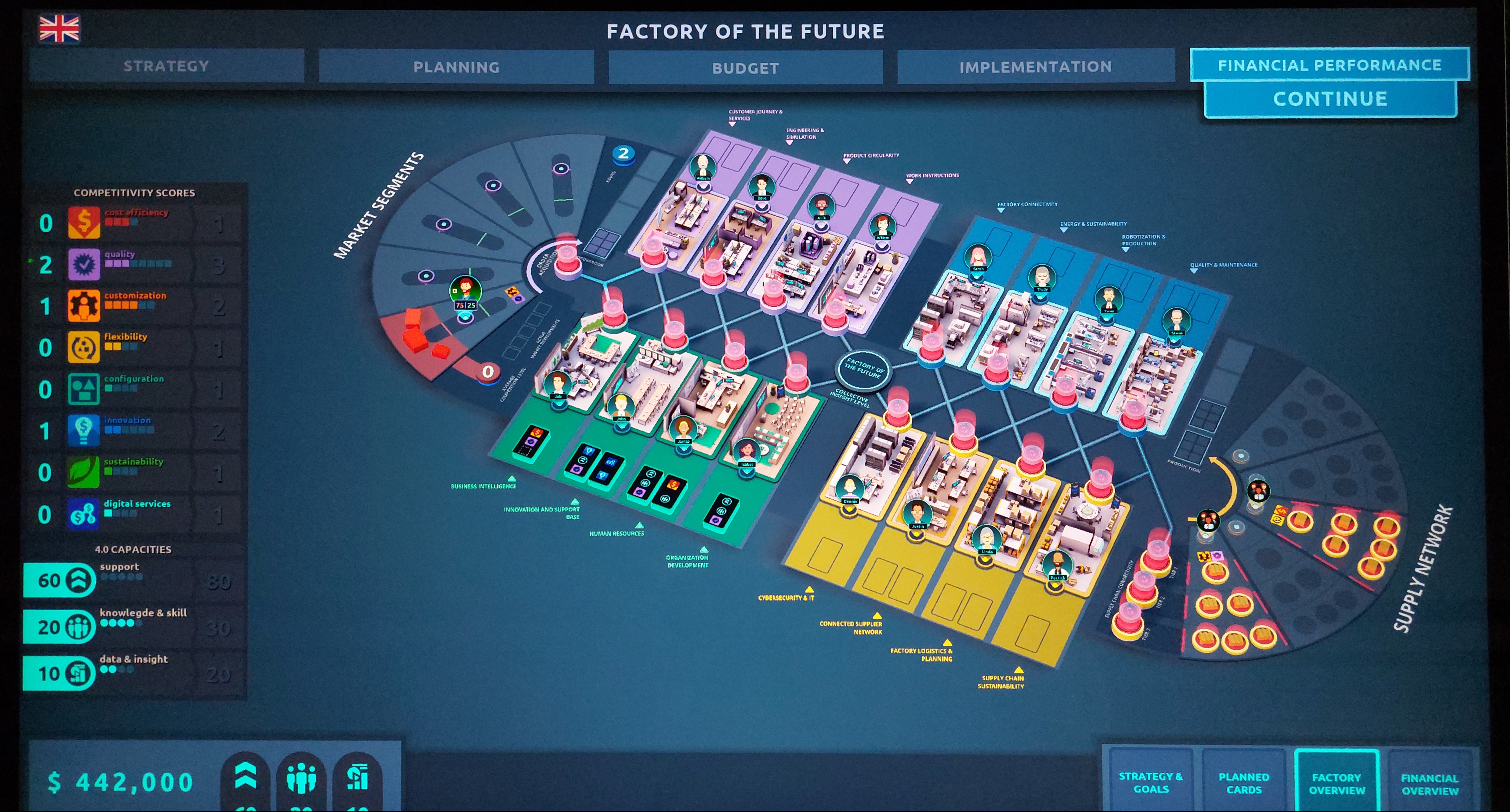
First, decide where the company wants to excel
The first task is to define the business strategy. The management team selects two priorities from eight competitiveness targets. Just as in real life, a manufacturer cannot excel at everything. Even recognised factories of the future make deliberate strategic choices and set their own priorities.
The team then chooses an existing strength as a starting point, such as support and engagement or IT. This helps to determine how the company will begin its transformation.
From then on, the strategic direction is set. Throughout the rest of the game, participants are constantly weighing up which investments and innovation projects contribute most to their chosen competitiveness targets.
Innovation requires more than just a budget
The participants translate their strategic choices into innovation projects. To this end, they use innovation maps, categorised by different themes and maturity levels.
Every investment requires financial resources. In addition, the management team takes into account the available capacity in terms of:
- Support and engagement
- Knowledge and skills
- IT
Innovation projects boost the company’s competitiveness and sometimes generate new resources. At the same time, they can place a heavy burden on the organisation.
The team therefore assesses the expected added value, the right timing and the available capacity for change for each project.
Every investment thus requires a balance to be struck between strategic added value and the organisation’s capacity to implement the change successfully.
Each round of the game reveals the consequences
The management team decides on innovation projects, market choices and collaboration with suppliers. The participants develop new market segments, engage suppliers and integrate them into the business processes in stages.
After each round, the simulation immediately shows the impact on:
- Market position and revenue
- Financial results
- Competitiveness
- Customer relations
- Available resources
- Organisational pressure
In this way, participants learn that strategic decisions always have consequences for the rest of the organisation.
An investment that seems sensible to one department may put extra pressure on other departments. Moreover, the organisation’s capacity for change also plays an important role.
Having too many innovation projects running at the same time increases organisational stress. Performance declines and key staff may end up taking time off work. The management team should therefore attempt to strike a realistic balance between ambition, available resources and the organisation’s capacity to absorb change.
Sirris holds up a mirror to the management team
Sirris experts run the workshop as facilitators. They don’t take over the decision-making: they observe the process and ask questions that make the participants think.
- How did the team decide on its strategy?
- Was that strategy followed consistently throughout the rounds of the game?
- How did communication go?
- Did everyone take part in the decision-making process?
- What factors hindered progress?
- What would the team do differently next time?
These questions reveal patterns of behaviour. They initiate discussions about teamwork, decision-making and internal communication. This automatically brings up issues that are rarely given explicit attention in day-to-day operations.

Case study: Hub4Industry experiences digital transformation in practice
In the summer of 2026, staff from Hub4Industry, the Polish European Digital Innovation Hub, attended the workshop in Genk. The group consisted of staff members from a variety of backgrounds and with a range of responsibilities. Afterwards, the feedback was extremely positive.
‘The workshop was the most inspiring part of our visit to Belgium. In particular, the combination of strategy, innovation, digitalisation, work organisation and process management made a real impression. We saw how every decision affects the entire organisation and how important collaboration is to carrying out a transformation successfully.’
The workshop also provided an opportunity to exchange experiences within the network of European Digital Innovation Hubs (EDIHs). In both Belgium and Poland, these organisations support manufacturers with their digital transformation. By sharing experiences, methodologies and tools, they strengthen both each other and the businesses they support.
Armed with new insights, the team returned to Poland to better support manufacturers there too.
Five insights from the Factory of the Future Serious Game
1. Strategy sets the direction for investment and innovation
Participants first decide on the areas where their company wants to be competitive. They then assess each innovation against that strategy.
The game highlights how quickly projects deviate from the chosen strategy. Setting a clear direction helps the team to prioritise investments and allocate resources effectively.
2. Collaboration accelerates change and determines the quality of decisions
Because each participant views the company from the perspective of their own responsibilities, decisions require constant consultation. During the game, participants learn how important communication and collaboration are for making the right decisions and preventing conflicts.
3. Setting priorities makes the transformation achievable
The simulation shows how limited resources determine how quickly a transformation can take place. Budget, expertise, IT resources and organisational capacity are not limitless. By prioritising projects, the organisation remains agile and manageable.
4. Data supports decision-making
The Factory of the Future Serious Game shows how data enhances decision-making. Through information about the company, the market and the suppliers, participants constantly gain new insights, giving them a more complete picture of each decision’s impact.
5. There is no such thing as a perfect strategy
The simulation shows that a strategy is not a fixed endpoint. Management teams constantly make adjustments based on new information, market developments and the organisation’s available capacity, with the chosen competitiveness targets remaining the benchmark for all decisions.
Experience the Factory of the Future Serious Game
Many companies realise that they need to go digital. The biggest challenge is deciding where to start and how to get everyone on board. The Factory of the Future Serious Game brings these challenges to life.
In the course of just a few hours, your management team learns what choices make a difference and what pitfalls are best avoided. This fosters a shared understanding and builds support for making the right decisions.
This makes the Serious Game a valuable first step for any manufacturer looking to accelerate its digital transformation. After the workshop, Sirris can provide further support to businesses. Possible next steps include an inspiring visit to a lab, a hands-on technology workshop, a feasibility study or individual guidance at the start of a transformation programme.
Book your workshop