What Sweden shows us and why it matters for Belgium
Sweden loses 19% of its economic value each year due to linear practices. This equals around 55 billion euros in missed or destroyed value. Circular strategies can retain a large share of it. Applied to Belgium, the current loss amounts to about 61 billion euros per year, of which 15 to 24 billion can realistically be recovered.
Where value emerges and why it disappears
The Value Hill in one minute
The Value Hill illustrates how value is built and lost. The model distinguishes four zones:
- Value creation: from raw material to finished product
- Missed value creation: opportunities lost due to inefficient design or underuse
- Value loss: value disappearing when products are discarded too early
- Overconsumption: usage that exceeds what is needed for the same quality of life
These steps reveal where the value gap grows and where circular solutions can intervene.
Overconsumption as a blind spot
The report explicitly includes overconsumption. At first glance, it seems economically positive because more is bought and produced. Yet it delivers little real societal value. Products are underused, written off too fast and replaced too early. This drives unnecessary material use, extra waste, resource depletion and environmental damage. It enlarges the value gap.
What this means for the technology industry
A sector present across the entire model
The technology industry appears in almost every sector of the Circularity Gap Report. It is central in Manufacturing (machinery, metal, industrial systems) and Mobility (automotive, drivetrains, charging technologies). It is partly visible in Construction through building technology, HVAC and smart systems, and in Mining & Extraction via extraction, equipment and intermediates. It shows up in Consumables through electronics, ICT hardware, batteries and plastics. It contributes both to value creation and value loss.
Where you already make a difference today
The technology industry can already retain significant circular value:
- In Manufacturing, major opportunities lie in remanufacturing, modular design, component overhaul and extending machine lifetimes
- In Mobility, the focus is on reuse and overhaul of critical parts, second-life battery applications, repair instead of replacement and circular service models
- In Consumables, such as electronics and technical plastics, value can be maintained through take-back, repair, refurbishment and design for dismantling and upgrading
- In Construction, opportunities lie in repair, overhaul, upgradeability and longer-lasting technical installations
Three strategic levers stand out
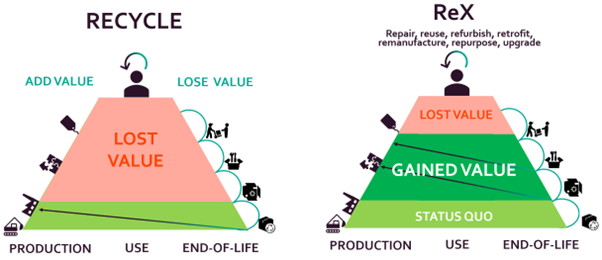
1. Lifetime extension and ReX
Long-term maintenance, overhaul, remanufacturing and modular design offer major opportunities. Machines and components that last longer generate lower costs and more value.
2. More intensive use and new business models
Services linked to a product and adapted business models can ensure that products are used more intensively and for a longer period.
3. Design that puts value retention first
Designing products and services in a way that supports value retention and makes it easier to achieve.
Across all sectors, the report shows the same pattern: the greatest value does not come from recycling, but from longer use, repair, remanufacturing and thoughtful design. This is exactly where the technology industry can act today.
Circular value retention as an economic lever
The circular transition goes beyond sustainability. It is a structural economic opportunity. Sweden shows that almost one-fifth of value disappears annually due to linear processes. Belgium faces a similar challenge. By preserving value, the technology industry can create new growth, lower costs and manage materials more intelligently. The logic is simple: what we keep, we do not need to produce again.
Summary
Belgium loses around 61 billion euros per year due to linear practices. With realistic circular strategies, 15 to 24 billion can be recovered. The largest gains lie in lifetime extension, ReX, more intensive use and circular design. The technology industry plays a key role.
Conclusion
Insights from Sweden make the value gap tangible and reveal the economic potential of circularity. Circular strategies offer realistic, profitable opportunities for Belgian technology companies. By focusing on value preservation, you strengthen both competitiveness and economic resilience.
Would you like to know which circular strategy best fits your activities?
The VLAIO-supported COOCK CIRKEL project gives you practical tools to apply remanufacturing and other value-creating approaches safely and effectively. This reduces risks and increases your chances of success.
Discover the CIRKEL project here
Another good starting point to explore circular value retention is:
Would you like to identify where your company can already capture circular value?
Our experts are ready to guide you in your next step.