A promising technology for limiting overheating in high-power batteries
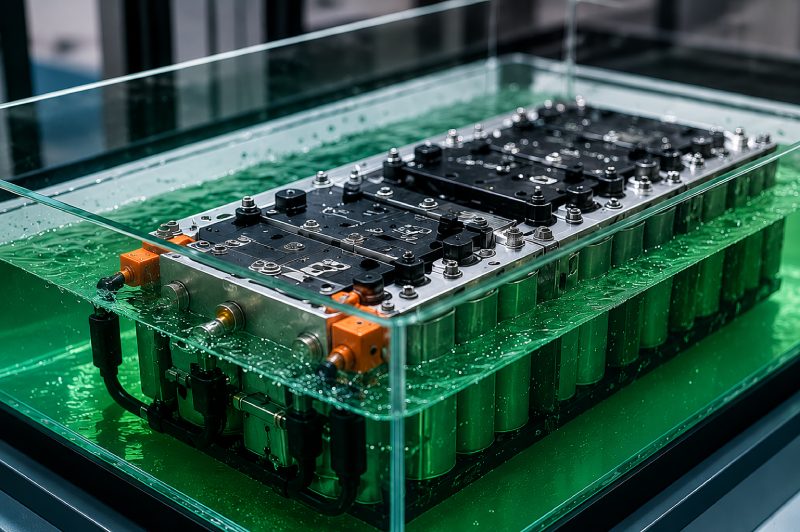
Immersion cooling of batteries involves fully or partially submerging the cells and certain components of the battery pack in a dielectric, i.e. non-conductive, fluid. This fluid dissipates heat as close as possible to its source, without interfering with electrical operation. In high-power or fast-charging applications, is this technique the ultimate solution for preventing overheating in Li-ion batteries?
A review of the scientific literature highlights promising benefits, particularly for applications with high power density and fast charging. However, it also reveals significant limitations: the cost of the fluids, integration challenges, material compatibility, flow control and the impact on cell lifespan.
This article analyses the principle of immersion cooling, its advantages over conventional solutions, its integration constraints and the conditions under which its implementation may be justified.
Direct contact for improved heat dissipation
Based on the reviewed literature, see the reference list below, immersion cooling stands out as a particularly effective solution for preventing overheating in battery systems exposed to high thermal loads. This is especially true for high-power-density and fast-charging applications (2) (8), such as Li-ion batteries used in automotive systems.
This approach relies on direct contact between the dielectric fluid and the surfaces of the electrochemical cells. The fluid may also come into contact with certain battery pack components, such as busbars and electronic parts. This direct contact reduces the overall thermal resistance of the system, leading to lower peak temperatures and improved thermal performance.
The benefits are most significant under demanding operating conditions. In such situations, conventional solutions such as air cooling or cold plates often reach their limits.
Advantages over existing solutions
The main advantage of immersion cooling lies in its ability to directly address the main thermal bottleneck in batteries. By significantly increasing the contact surface between the fluid and the cells, this technology enables more efficient heat transfer than conventional methods.
A significant improvement over air cooling
Compared with air cooling, the advantage is substantial. The limited thermophysical properties of air are insufficient to dissipate heat under heavy load conditions. Immersion cooling, on the other hand, provides significantly higher heat transfer coefficients. This is especially true for two-phase systems that make use of latent heat of vaporisation (1) (5) (8).
A more nuanced advantage over cold plates
The comparison with indirect liquid cooling is more nuanced. Cold plate systems are technically mature and ensure good thermal distribution. However, they remain limited by thermal contact interfaces. Immersion cooling overcomes these limitations by directly cooling the cells and interconnections. In some cases, however, a well-optimised indirect liquid-cooling system may offer better thermal uniformity (2).
A significant safety benefit
Dielectric fluids can help limit or delay the propagation of thermal runaway. This represents a major safety benefit for battery systems. This effect can be explained by their heat absorption capacity, electrical insulation and, in some cases, their low flammability or even non-flammability (5) (6).
An effective, but not universal solution
Based on the available literature, immersion cooling cannot be considered universally superior. Several trade-offs must be taken into account.
The first concerns the high cost of dielectric fluids (5) (8). The second relates to integration constraints linked to sealing and material compatibility. The third concerns the potential increase in system mass and volume. Thermal uniformity at module level also strongly depends on even flow distribution (2). In some cases, this may be lower than in well-optimised indirect liquid-cooling systems.
Finally, recent experimental results suggest that improved thermal performance does not always lead to slower electrochemical ageing. Under certain operating conditions, phenomena such as lithium plating may be promoted (4). This phenomenon involves the deposition of metallic lithium, which can eventually poison the graphite anode.
Constraints for industrial integration
Despite its advantages, immersion cooling comes with several important limitations. These constraints must already be considered during the design phase.
Cost and chemical compatibility
The first issue concerns the cost and availability of dielectric fluids. These fluids remain significantly more expensive than conventional water-glycol-based solutions (5) (8). Chemical compatibility with system materials is another key concern. Thorough validation is required, since the fluid comes into direct contact with several system components.
Flow control
Managing the fluid flow also represents a significant technical challenge. Poor heat distribution may lead to considerable temperature gradients within the module, which can compromise thermal uniformity.
The design of the hydraulic circuit and the flow field is crucial to overall performance. Computational Fluid Dynamics, or CFD, plays a key role here. It enables engineers to study heat transfer in combination with fluid flow.
Cell lifespan
In addition, the long-term effects on battery lifespan are still insufficiently understood (5). Certain studies (4) indicate that modified thermal conditions may influence electrochemical degradation mechanisms. This requires further investigation.
Complexity of two-phase systems
Two-phase systems provide high thermal efficiency, but they also introduce additional complexity: boiling phenomena, phase transitions and the risk of insulating vapour film formation. These effects must therefore already be considered during system design.
A technology for specific use cases
Immersion cooling is a promising technology for the thermal management of Li-ion batteries. It is particularly suited to demanding applications, such as ultra-fast charging or high-power systems. It offers superior thermal performance under severe conditions, as well as potential advantages in terms of safety and integration.
However, several challenges still need to be addressed before this technology can be adopted on a large scale. The most important challenges concern cost, material compatibility, flow management and the impact on cell lifespan.
Immersion cooling should be considered as a complement to existing technologies. Its suitability strongly depends on the use case and the system constraints.
Are you working on thermal management for batteries or electronic systems?
Sirris experts are happy to support you in the analysis, modelling and validation of your cooling solutions. Let’s discuss your project together.
Interested in battery innovation?
Developing high-performance battery systems goes beyond thermal management. Discover how Sirris is developing modular battery modules, intelligent energy management systems and hybrid energy systems for demanding applications through the SHIFT project.
partners
Financed by