In our daily lives, surfaces we come into frequent contact with, such as doorknobs, railings, elevator buttons, and handrails, play a critical role in the transmission of bacteria and pathogens. In high-traffic environments like hospitals, schools, airports, and public transportation, controlling bacterial spread is a key public health priority.
Silver-based coatings: effective but impactful
For years, industries have turned to antibacterial coatings to mitigate these risks, with silver nanoparticles becoming one of the most commonly used agents due to their strong antimicrobial properties.
While silver nanoparticle-based coatings are effective in killing bacteria on contact, they come with notable environmental drawbacks. Silver must be mined, processed, and synthesized into nanoparticle form before being incorporated into coatings. The mining process alone contributes significantly to environmental degradation, including habitat destruction, soil and water pollution, and carbon emissions. Producing nanoparticles is also energy-intensive and often requires the use of hazardous chemicals. These activities not only generate harmful waste but also present significant risks for workers and communities near mining or manufacturing facilities.
A chemical-free alternative: laser texturing
Recognizing these issues, researchers and industries have begun exploring more sustainable alternatives. One such promising technology is femtosecond laser surface texturing. Unlike traditional antibacterial coatings, this method relies on ultrafast laser pulses to create precise micro- and nano-scale patterns on the surface of a material. These structures physically inhibit the adhesion and growth of bacteria without relying on chemical agents or metallic nanoparticles. Since the process is purely physical, it does not involve any chemical compounds, eliminating the environmental and health risks associated with antimicrobial agents.
LCA-based environmental comparison
A recent life cycle assessment (LCA) evaluated the environmental performance of femtosecond laser texturing in comparison to a conventional antibacterial coating that includes silver nanoparticles. The assessment focused on a typical doorknob surface area (0.01 m²) and considered all key stages: material sourcing, production, application, and waste management.
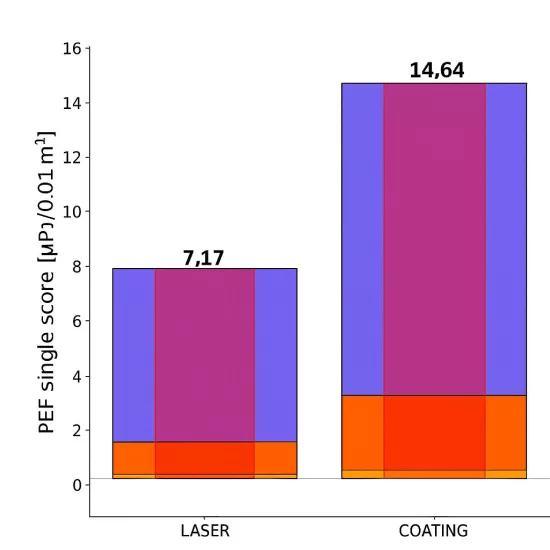
The results revealed major environmental hotspots in the conventional method. The production and application of the powder coating, which additionally to silver nanoparticles also include zirconia toughened alumina (ZTA), epoxy resin, and additives, contribute to high climate change potential, non-renewable energy resources, and mineral resource depletion. In contrast, the main contributors to femtosecond laser process environmental impact was electricity consumption during the laser texturing phase.
Impact breakdown and key results
The LCA's single-score analysis showed that the femtosecond laser process generated less than half the environmental impact of the conventional coating. Even assuming equal durability for both treatments, the laser option remained significantly more sustainable across all measured categories: acidification, climate change, non-renewable energy sources, use of minerals and metals and ozone depletion potential.
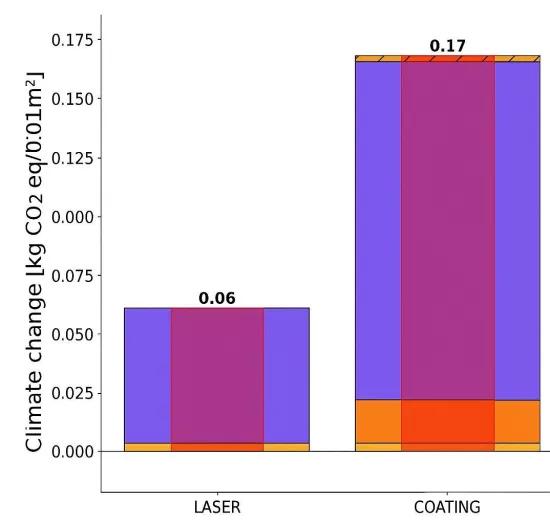
Another important result coming from the LCA is the significant reduction of 64% in the climate change impact by using laser texturing in place of anti-bacterial coating. The total GWP is 0.062 kg CO2-eq for the laser and 0.168 kg CO2-eq for the coating.
Conclusion
Femtosecond laser surface texturing represents a significant step forward in designing antibacterial surfaces that are both effective and environmentally responsible. With strong environmental credentials backed by life cycle data, femtosecond laser texturing is well-positioned to lead the next generation of surface engineering technologies. Laser texturing eliminates the need for mined silver and harmful chemicals while reducing climate impact by 64% in door-handle applications.
Discover the FEMTOFUNC project
This case study is part of the broader FEMTOFUNC research on biomimetic surface functionality.
Series of LCA studies on the application of femtosecond lasers
In a series of 4 parts, we briefly describe our findings and show the extent to which a femtosecond laser outperforms coatings in terms of ecological footprint:
Part 1: femtosecond laser texturing as a sustainable surface solution
Part 2: laser texturing vs. hydrophobic coatings in wind turbines
Part 4: laser texturing vs. hard chromium coatings in bearings