Smart manipulation can significantly increase your metals’ lifespan
Harsh environments are often considered the enemy of metals and materials. Yet, with the right approach to material properties and environmental conditions, even challenging settings can become manageable. Understanding how to manipulate the behaviour of materials can open doors to opportunities that might seem impossible at first glance.
Lower pH value = higher corrosion potential
What happens with an aluminium plate intended to operate in alkaline conditions? Classical theory suggests that at certain pH levels, aluminium would remain in the free corrosion state. This means there would be no passivation phase, and it would thus become highly susceptible to corrosion.
The reality, however, proves slightly different when we perform a cyclic polarisation scan, as illustrated in Figure 1. When varying the applied potential on the aluminium and measuring the current response, we observe some degree of passivation. The corrosion potential, represented as Ecorr, indicates that aluminium at pH 9.5 is indeed more prone to corrosion than at pH 11, -1.2V vs -0.55 V, respectively.
Adding stainless steel to the equation
But things get more interesting when the aluminium is in contact with stainless steel: the galvanic interaction immediately shifts the potential from the corrosion potential to the working potential (WP, dashed lines).
For aluminium at pH 9.5, the working potential actually exceeds the pitting potential (EpitpH9.5 = -0.7 V), signalling a risk for pitting corrosion. Meanwhile, aluminium at pH 11 in contact with stainless steel finds its working potential significantly below the EpitpH11. This means that pitting corrosion is no longer a concern, even in a more alkaline solution.
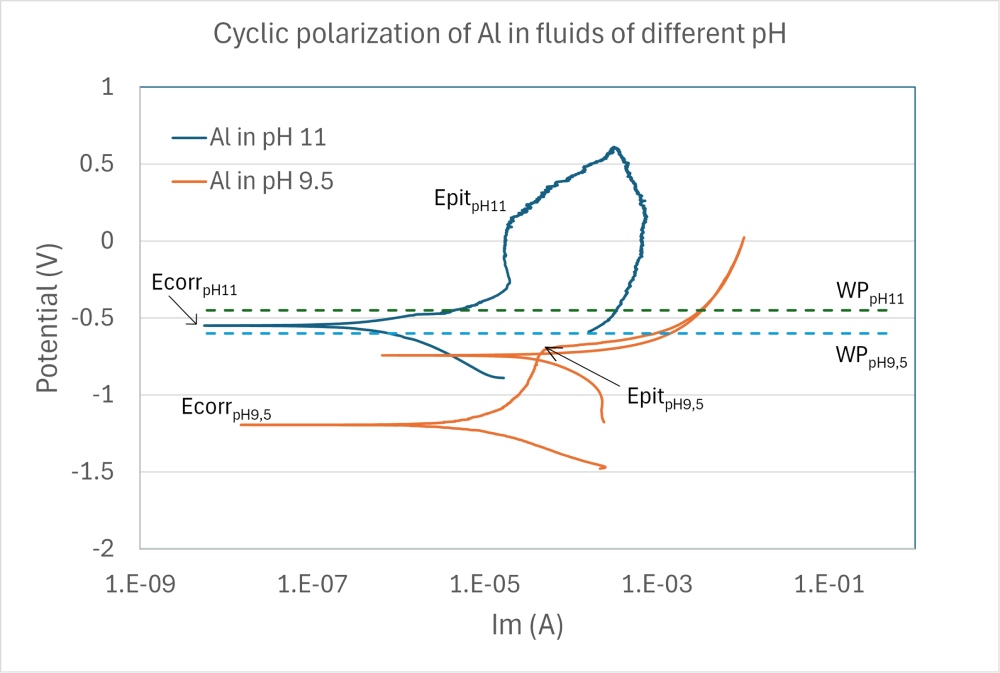
Figure 1. Cyclic polarisation scans of two aluminium plates in contact with stainless steel, measured in electrolytes with different pH values.
Electrolyte composition
Another key factor is the composition of the electrolytes. Different ions or additives in the solution can act as corrosion inhibitors. They will enhance material performance, even in harsh conditions.
Conclusion
Summarising: by carefully adjusting some variables - pH, conductivity, and ion composition - you can improve the corrosion resistance of your material. Electrochemical testing will grant you insight in how to tune these variables.
Ready to make your metals last longer?
Have you considered how smart manipulation can optimise your metal’s performance in a specific environment?
Sirris helps you assess and optimise electrolyte performance at laboratory scale. Together, we give your materials the best chance to thrive in controlled corrosion environments.