There is a direct link between moisture and life-shortening technical failures in wind turbines, independent research by the German Fraunhofer Institute confirms.
The underlying causes of frequent and costly failures in power inverters have long been largely unknown. Research by Fraunhofer IWES which studies defects in wind turbine generators (WTG) joined an extensive group of research centres and companies to find the root causes and drivers in these defects. The results challenge the widely held assumptions that fatigue and turbine age contribute significantly to power converter failures. Indeed, it was largely assumed, for a long time, that wind turbine failure was caused by fatigue effects in the power electronics and temperature cycling. Instead, research seems to indicate that humidity and condensation are major factors in power converter failures.
Analyses of field data from an international fleet of wind turbines clearly show that damage mechanisms, as found in other electronic applications, do not play a relevant role in wind turbines. Instead, prominent, seasonal patterns of defects were observed, indicating that climate and environmental influences appeared to be critical stressors, humidity in particular. The question is in fact: what levels of humidity and temperatures are inverters in turbines actually exposed to?
Field research
The recent study, 'Humidity in Power Converters of Wind Turbines — Field Conditions and Their Relation with Failures', studied the humidity and temperature aspects in more detail. The paper summarises the results of field measurement campaigns on 31 wind turbines from seven different manufacturers across three continents (Europe, North America and Asia). A great variety of turbines was subjected to measurements: onshore, nearshore and offshore wind turbines, with inverters in the nacelle or tower base, with air- and water-cooled inverters.
The study shows that climatic influence depends on three factors:
- the location of the wind turbine with its specific climatic environmental conditions,
- turbine design and operation,
- the type of cooling used for the inverters.
The turbine data and analysis allow us to verify if a link can be established between component failures and the climatic conditions they are exposed to, which is an important step towards a better understanding of the critical factors and mechanisms behind failure. The study confirms the impact of climatic conditions on electrical failures: the researchers noted seasonal variations in the number of phase module failures in a fleet of wind turbines in India and Scandinavia, specifically, that the months with a high number of failures coincided with rainy periods, representing periods when absolute humidity is highest. This led to the conclusion that humidity and/or condensation are significant risk factors for phase module failures.
Moisture inside the inverter cabins was also investigated in relation to air humidity inside the turbines: this showed that because the temperature level of the inverter components is largely determined by the operating point and cooling system settings, the risk of condensation in the power inverter increases directly with the dew point temperature.
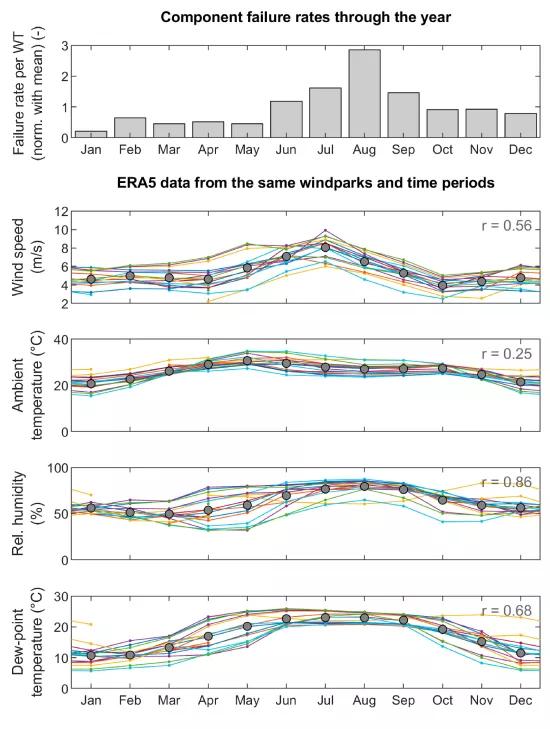
Seasonal variation in phase module failure rate in a wind turbine fleet with liquid-cooled power converters in India, based on failure data based on 590 years of operation of the wind turbines, with corresponding monthly wind speed and environmental conditions. Each line represents a wind farm, the grey dots represent the average across the farms, r describes the correlation with the percentage of failures (Source: Fraunhofer IWES)
In de loop van een eerder uitgevoerd, uitgebreider onderzoeksproject, eveneens door Fraunhofer IWES, werd data verzameld van meer dan 10.000 windturbines. Het project gaat over meer dan 20.000 werkingsjaren in het totaal. De data is afkomstig van turbines van meer dan 12 verschillende producenten, van verschillende ouderdom op onshore en offshore locaties verspreid over de hele wereld. Deze grote hoeveelheden data bevatten heel wat informatie. Uit het onderzoek bleek onder meer dat onderdelen zoals de fasemodulatie componenten en stroomrails (busbars) de voornaamste kostenfactoren zijn en dat de betrouwbaarheid van deze belangrijkste omvormercomponenten in hedendaagse windturbines niet hoger is dan die van turbines die 10-15 jaar langer operationeel zijn. Meer defecten waren duidelijk op te merken in verschillende gebieden tijdens periodes met een hoge vochtigheid.
In the course of an earlier, more extensive research project, also by Fraunhofer IWES, data was collected from more than 10,000 wind turbines. The project covers more than 20,000 operating years in total. The data comes from turbines of more than 12 different producers, of different ages at onshore and offshore locations around the world. These large amounts of data contain a lot of information. One of the things the study found was that components such as phase modulation components and power rails (bus bars) are the main cost factors and that the reliability of these key inverter components in contemporary wind turbines is no higher than for turbines which have been operational for 10-15 years longer. More defects were clearly noticed in different areas during periods of high humidity.
Power inverters in wind turbines were found to be responsible for an average of one failure every two years, making them one of the most frequently failed turbine components. The analysis of the field data clearly shows that fatigue-related damage mechanisms in the power semiconductor domain do not really play a relevant role for defects in the field. Again, the results show that more attention is required for the impact from the environment, especially humidity.
Impact of O&M costs on LCOE
Today, the wind power industry operates under extremely high competitive pressure and the entire value chain is subject to additional price pressure. To compete successfully with other power generation systems, the cost has to come down, while the durability and reliability has to increase further.
The O&M costs of wind turbines account on average for 25-40 per cent of their LCOE (levelised cost of energy). Much of this is due to maintenance and repair works. On top, there is production loss due to turbine failure (downtime), where, especially for offshore turbines, repairs can be logistically complex and often cannot be done at short notice. A Fraunhofer IWES study also calculated this cost: on an annual basis, repair costs and production losses of the 50 GW of wind turbines currently installed in Germany amount to around €200 million and around 200 gigawatt hours of energy are lost, enough to power 55,000 families for a year.
Besides an appropriate maintenance strategy, improved reliability of components and systems, especially those with a high failure risk, is therefore one of the main levers for further lowering the LCOE. However, it is only possible to develop effective measures when the causes and mechanisms behind defects are well understood.
Power electronics crucial in energy transition applications
These research projects demonstrate that, whether onshore, nearshore or offshore, controlling the interior climate of the turbine and inverter control cabinet is crucial to reduce the failure rate, and ensure maximum turbine operating time and protection. In the light of these findings, it is recommended to consider the environmental conditions to which the turbines are exposed. Especially absolute humidity is important and strategies should be implemented to control the humidity within the nacelle and inverter cabin to minimise the risk of condensation.
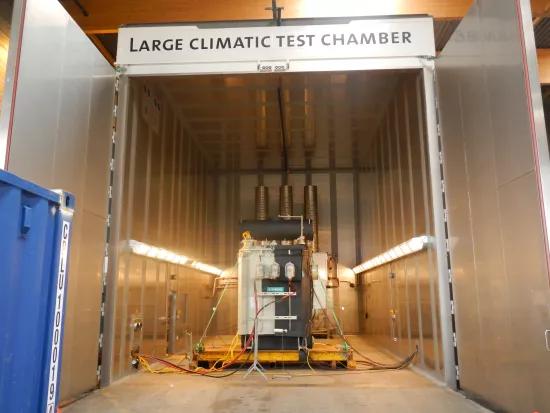
One way of evaluating the impact of moisture and condensation on turbine components - but also other energy transfer applications equipped with power electronics (think rectifiers in hydrogen electrolysis) - is to test them extensively during the development process. This can be done in dedicated climatic chambers, like the one Sirris set up in the Port of Antwerp. In there, climatic conditions can be simulated as they occur in reality, allowing weaknesses in the design to be detected at an early stage, and necessary measures to be taken before or during installation. Sirris' large climatic chamber is almost unique in its kind in Europe where large multi-MW power inverters, but also, for example, battery systems, can be tested at 95 per cent relative humidity and high temperatures. In the context of energy transition developments which increasingly use 20-foot or 40-foot containers to house power electronics, transformers or batteries, Sirris is working on the energy transition project 'ETF Harsh R&D test'. As part of this project, Sirris aspires to enlarge the existing climatic chamber. Read more about our climatic chamber here!