The WILLOW consortium tests state-of-the-art corrosion monitoring technologies that will drastically reduce maintenance and inspection costs
From seabed experiments to drone-based inspections, the EU-funded project is already progressing with field tests on load estimations, coating degradation, and pitting corrosion at the Blue Accelerator platform in Ostend, Belgium.
WILLOW, “Wholistic and Integrated Digital Tools for Extended Lifetime and Profitability of Offshore Wind Farms”, aims to achieve an integrated system that will provide an open-source, data-driven health aware curtailment strategy to the offshore wind farm operators. With a 5.8 million euro budget granted within the framework of the Horizon Europe programme, it is expected to contribute to a 50% reduction on the inspection costs, a 5-years lifetime extension of offshore wind farms, a 4% reduction in noise pollution and up to 10% reduction of LCOE (Levelized Cost of Energy), between 3.5 and 4.5 €/MWh.
One of the key use cases of the WILLOW project is the Blue Accelerator coordinated by POM West-Vlaanderen, a maritime innovation and demonstration platform based on a monopile structure, located 500 metres offshore in Ostend, Belgium. Within this setting, one of the project’s main goals is to investigate the of use electrochemical measurements to detect pitting corrosion, a particularly aggressive form of corrosion that penetrates the material’s surface and creates local stress concentrations, which are critical factors in the fatigue life of offshore structures. This task will be led by SIRRIS, as there is currently no commercial sensor available that can effectively measure this type of corrosion.
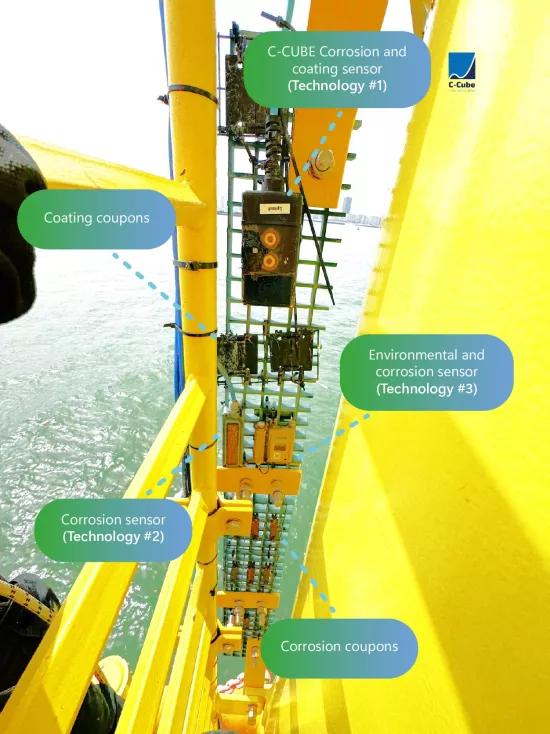
Another objective is to improve our general understanding of offshore corrosion and coating degradation rates to support the development of forecasting models. To support this objective, commercial sensors (MetriCorr) have been installed on the Blue Accelerator monopile specifically in the splash, tidal and submerged zones. Until now, sensors had only been deployed in the submerged zone, both inside and outside the monopile. These commercial sensors are designed to monitor uniform corrosion rates (based on the Electrical Resistance principle) and environmental conditions such as submersion status, water conductivity, and temperature. In addition, newly improved corrosion and coating degradation sensors, produced by project partner C-Cube, were also installed on the monopile in all the zones. The C-Cube sensor is based on electrochemical measurement principles, with which we want to study if additional information on the active corrosion and coating degradation processes can be obtained.
Moreover, corrosion and coating coupons were installed on the Blue Accelerator in January of this year. These coupons have been placed in various locations: the splash zone, tidal zone and submerged zone, both inside and outside the monopile. The purpose of placing them in different environments is to assess how corrosion processes affect the materials under varying exposure conditions. After several months of exposure, early findings are providing crucial insights for the development of corrosion sensors. These include evidence of severe pitting in the splash zone, significantly more advanced corrosion in the tidal and external submerged zone compared to the internal area and predominantly uniform corrosion in the submerged zone.
Another key experiment within the project is the mudline corrosion test, conducted approximately 20–30 metres from the Blue Accelerator site. The area where the monopile enters the seabed is critical due to structural loads but remains largely unmonitored because of inspection difficulties and limited data below the mudline. Corrosion behaviour in this zone is still poorly understood, especially regarding microbiologically induced corrosion (MIC) and potential coating degradation caused by pitting and seabed scouring.
With support from Antwerp Underwater Solutions a 193.7mm diameter, 2.5 m-long pipe was installed in April at a depth of 30–40 cm under the seabed. The initial pipe was installed without sensors as a precaution to reduce potential losses, considering the high cost of deploying sensors if the experiment was unsuccessful. As the initial installation was successful, a second pipe equipped with sensors will be installed in September 2025. Inside this second pipe, uniform corrosion sensors, one of which is specifically developed for this application by partner C-CUBE, will be fixed at the lower end, being buried in the mud, to monitor corrosion in this challenging, unobservable environment.
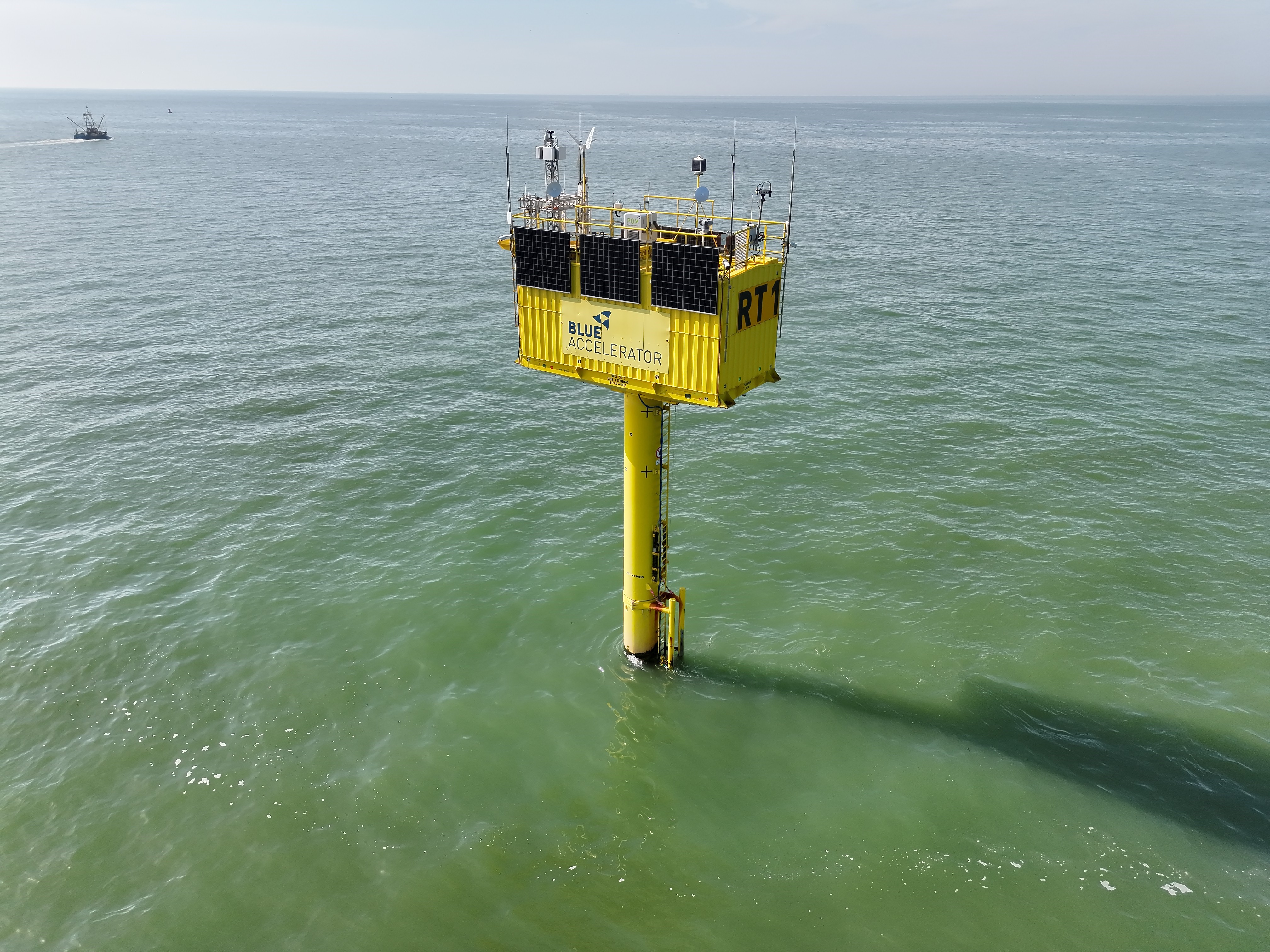
Finally, during the last week of June, flight tests were carried out using Hyperion, Alerion’s proprietary drone, which has recently been equipped with a thermal imaging camera. The objective was to capture thermographic data to support the training of an AI model for corrosion damage detection. Two types of inspections were performed in the Blue Accelerator. The first consisted of vertical flights from sea level to the top of the pole. The second involved a spiral ascent around the pole flying in circles from the sea level to the top end of the pole. In both cases, thermal and RGB images were successfully captured.
WILLOW involves 12 partners from 5 European countries (Spain, Belgium, The Netherlands, Norway and Germany): CEIT (coordinator), 24SEA, ALERION, BASQUENERGY Cluster, C-CUBE, FLANDERS MAKE, NORTHER, SIRRIS, SINTEF, TSI, VUB and WÖLFEL. For more information about the project, visit the official website: www.willow-project.eu, follow the LinkedIn page @WILLOW Project EU and watch the official video.
Discover the WILLOW-project
This article is part of the European WILLOW project, which focuses on advanced corrosion monitoring and digital tools to extend the lifespan of offshore wind farms, halve maintenance costs and increase energy efficiency.
WILLOW newsletter, now available!
Would you like to follow progress made in the WILLOW project?