A smart tool to help you predict temperatures with ease
Heat plays a decisive role in machining performance, yet many teams lack a fast and accessible way to estimate its impact. To address this need, Sirris developed a cutting-temperature prediction module that offers reliable insights early in the planning phase, allowing you to adjust machining parameters before problems arise on the shop floor.
Why temperature prediction matters on the shop floor
Cutting operations generate significant heat, and this thermal load influences far more than tool wear alone. It affects chip formation, surface integrity, dimensional accuracy, and even the stability of the entire process. When temperatures climb too high, materials react unpredictably and tools degrade at a pace that disrupts planning and increases costs. By understanding this thermal behaviour before you start machining, you can make targeted adjustments to speed, feed, or tool design. This proactive approach reduces trial-and-error, lowers risk, and supports a smoother transition from planning to production.
Different routes to estimate cutting temperature
To predict cutting temperatures, engineers can choose between three main methods. Each offers a different balance of precision, complexity, and resource requirements, allowing teams to select the approach that best fits their context.
1. Empirical measurement
Empirical methods rely on direct measurement using infrared cameras or embedded thermocouples. These techniques deliver accurate, high-resolution readings of the tool–chip interface. However, they require specialised equipment, careful calibration, and controlled test conditions, making them difficult to integrate into everyday production workflows.
2. Numerical simulation
Finite element analysis (FEA) provides detailed thermal maps that describe local temperature peaks, transient effects, and complex interactions between tool and workpiece. While this level of insight is valuable, it demands substantial preparation, including material data, meshes, and boundary conditions.
As a result, FEA often becomes a powerful but slow option, better suited to in-depth studies than to rapid decision-making on the shop floor.
3. Analytical modelling
Analytical models take a more pragmatic path. They use simplified physics and basic machining inputs to estimate average temperature levels near the tool–chip interface. Models such as Cook’s equation or Hahn’s moving heat-source solution offer predictions that are less detailed than those from numerical simulation, yet still highly useful for early-stage optimisation. Although they cannot capture transient phenomena or local variations, these models enable fast screening of cutting conditions and support decisions when time, data, or resources are limited.
Why industry still benefits from fast analytical insights
Analytical predictions remain essential for engineers who need quick guidance without heavy setup requirements. They help teams assess heat levels when working with new materials, validate initial parameter ranges, and reduce the number of test cuts needed during setup. By offering consistent and repeatable insights, these models also create a shared reference across engineering and operations, improving communication and supporting smoother process development.
Analytical models support:
- Early identification of thermal risks
- Shorter setup and testing cycles
- Reduced tooling costs
- Faster validation of new materials
- More stable machining during ramp-up
How Sirris supports your temperature predictions
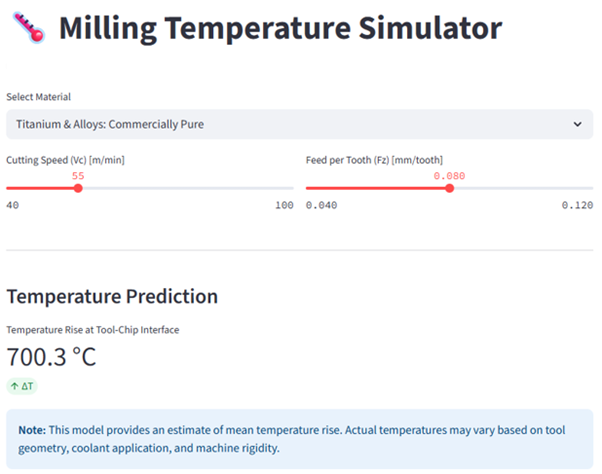
Sirris combines scientific expertise and industrial experience to deliver a temperature-prediction tool tailored to real production needs. With a small set of inputs, the tool produces fast, clear predictions that help you refine your machining parameters at an early stage.
Here’s a quick preview from our simulation module, showcasing how simple inputs can yield actionable thermal insights within seconds.
Summary
Cutting temperature drives tool life, part quality, and process stability. Fast prediction helps you avoid unnecessary trials and make better early decisions. The Sirris tool offers an accessible and efficient way to estimate heat levels before machining begins.
Conclusion
Reliable temperature insight brings clarity to your machining decisions. You do not always need complex simulations or specialised measurement setups to achieve this awareness. With the Sirris temperature module, you gain early visibility into thermal risks, strengthen your planning, and support a smoother path from design to production.
Would you like to explore how the Sirris temperature-prediction modulecan support your machining decisions?
Reach out to our expert Samuel Milton to discuss your process needs and discover how this solution can fit into your workflow.