EUDR Reform: an overdue modernisation for the tech industry
When we think of iconic product designs, the minimalist and elegant look of Apple’s iPhone immediately comes to mind. Its sleek lines, rounded edges and intuitive interface have captured global attention – and have been carefully protected through registered design rights. Design rights are an often underestimated form of intellectual property protection, especially for companies with vast and quickly developing product lines. With relatively smooth and low-cost registration processes, design rights can provide quick and effective protection against product imitation.
However, the original framework for European design law is over 20 years old and needed modernisation. Recognising this gap, the EU Design
Reform Package was launched, comprising a recast of the European Designs Directive (1998) and amendment of the Community Design Regulation (2002). With this legislative reform, design protection is better adapted for today’s era of digital designs and evolving technologies, including 3D printing. One of the reform’s key goals is also to make the European spare parts aftermarket more open to competition.
Why the EU Design Regulation (EUDR) is being implemented
Under the CDR, design rights protected a product’s look, resulting from its attributes such as lines, contours, colour, shape, texture and/or materials of the product itself. In other words, the guidelines focused on ‘traditional’, physical products.
Today’s markets have shifted from these solely physical products to more hybrid or even full digital-first experiences – which now cover everything from connected devices to purely software-driven environments. The CDR simply did not grant sufficient legal protection for these new types of products. The EU recognised this and has aimed to address these shortcomings with these EUDR reforms.
What changes with the new EUDR?
First of all, the name. The Community Design Regulation will be rebranded as the European Union Design Regulation. All Community Designs will be renamed European Union Designs. Besides the changes in wording, there are also more substantial changes. We will go over the most important ones.
Digital and animated designs are now covered
The definitions of ‘design’ and ‘product’ have been broadened, to give applicants a greater scope of protection. The new definition of ‘design’ is:
“The appearance of the whole or a part of a product resulting from the features, in particular the lines, contours, colours, shape, texture and/or materials, of the product itself and/or of its decoration, including the movement, transition or any other sort of animation of those features.”
The updated definition for ‘design’ now includes animation. This is to be understood as a progressive change of the design features, with or without retaining their identity, through both movement and/or transition.
The definition of ‘products’ has been revised to include both physical and non-physical items, where protection can be granted even for sets of articles, spatial arrangements of items intended to form an interior or exterior environment, symbols, logos, surface patterns and graphical user interfaces.
The expanded definitions of ‘design’ and ‘product’ have far-reaching implications for design applicants and the market, allowing these non-tangible designs to be protected from product imitation.
Stronger protection against 3D copying
The scope of the exclusive rights conferred by a design has been extended to 3D printing.
Design holders can now prevent:
- Downloading, copying or sharing of 3D files that reproduce a protected design.
- Creating, distributing or sharing any medium or software that records or represents the protected design.
This is especially relevant for tech companies creating hybrid products or sharing design files with their partners and subcontractors.
The ‘repair clause’ for spare parts protection
After years of uncertainty, a definitive ‘repair clause’ has come to fruition, affecting spare parts protection. ‘Must-match’ parts, needed to restore the original appearance of a product, can no longer be protected by design rights. This rule applies strictly to repair purposes, and it mandates that the replacement part must visually match the original part. This ensures better consumer choice, enables independent repairs, and prevents manufacturers from monopolising spare parts. The new rule applies uniformly across the EU, with an eight-year transition period until 9 December 2032.
Unified, simpler application process and fees
Another goal for the reform was to make the application process more streamlined and accessible. The changes affect every step of the process, from number of designs to fees:
- You can now file up to 50 designs in a single EU application – even across different product categories.
- This is particularly useful for companies launching product families or connected ecosystems (such as an app, a wearable, packaging or GUI designs together). - All EU design applications must now be filed directly through the European Union Intellectual Property Office (EUIPO), instead of through national offices, thus streamlining the application process.
- Significant changes to the fee structure for both applications and renewals.
- The fee structure aims to be more transparent and easier to manage by combining separate fees in the application process.
- Some of the official fees are subject to a reduction, others will be increased.
- Removal of following fees:
- Late payment of the registration or deferment of publication
- Recording and registering a transfer
- Cancellation of the registration of a licence or other right
- Inspection of files
- Communication of information in a file
- Issuance of certified and uncertified copies.
New design symbol: Ⓓ
A new Ⓓ symbol has been introduced. Known as ‘the design notice’, it allows companies to indicate that a product is protected by design rights. Both design holders and third parties, with their consent, will be able to display the design notice on their products. Much in the same manner as Registered Trademark and Copyright symbols have been used in the past.
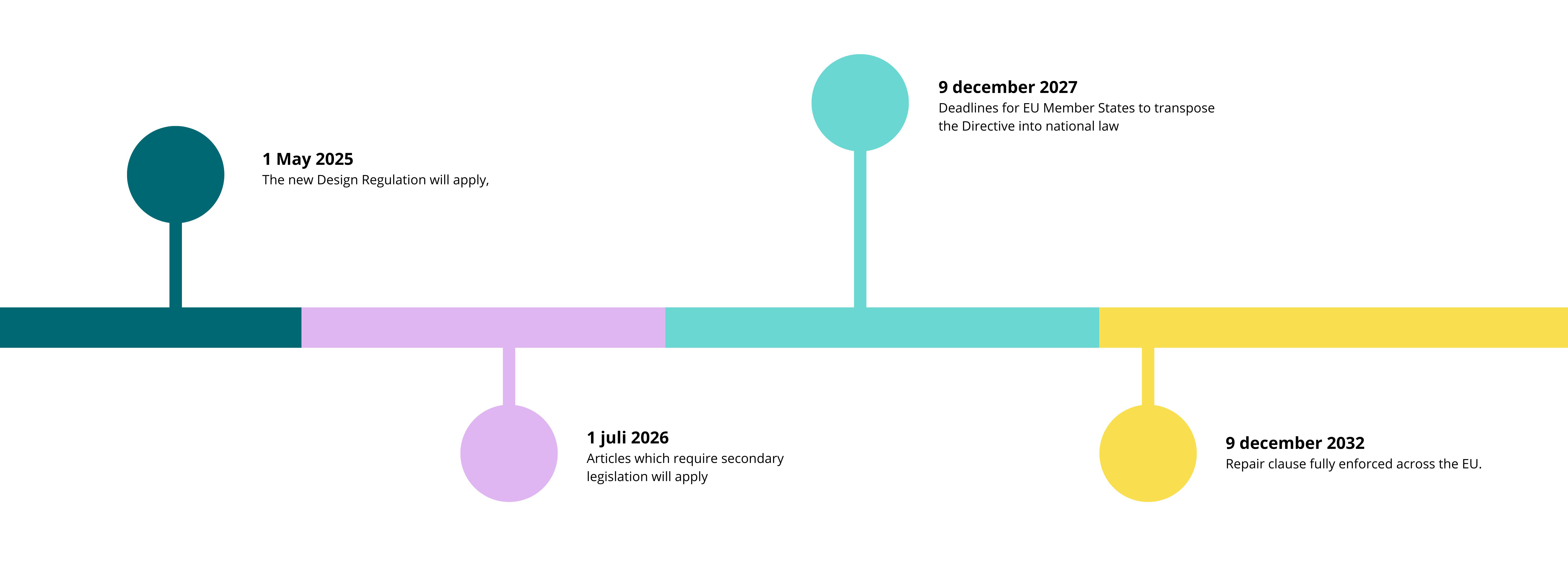
Timeline of implementation
While the Amending Regulation entered into force on 8 December 2024, the containing amendments will be rolled out over time:
Getting ahead of the curve as a tech company
Now that we are up-to-date on all the upcoming changes, what can tech companies do to reap the benefits? Here are a few possibilities:
- Audit your product designs – including GUIs, app animations and packaging elements.
- Strategically group up to 50 related designs into one EU application to optimise costs.
- Review strategies for managing spare parts and repairable products.
- Prepare to use new digital application formats after July 2026.
- Begin applying the Ⓓ symbol to raise awareness about registered design protection.
Steps like these will allow you to get a head start on the competition and help to optimally protect your designs.
Protect your digital assets with the new EUDR
In a nutshell, the EU Design Reform is more than an administrative update, it is a strategic shift that opens new protection opportunities for innovative, digital and modular designs. Simplified registration, expanded protection for digital assets, and stronger enforcement tools… these all represent a critical opportunity for tech companies to future-proof their design portfolios. Now is the time to review and update your design strategies, so as to take full advantage of the new framework.
For more information, visit the EUIPO website or consult updates from FOD Economy.