

EcoEndo | Eco-friendly Endoscopy

Reinventing endoscopy to meet tomorrow's health and environmental challenges
EcoEndo aims to provide medical device manufacturers with a sustainable alternative to traditional endoscopes, combining medical efficacy, patient safety and a reduced environmental footprint. Using innovative actuation technologies and a rigorous eco-design approach, the project aims to design a device that is easier to recondition and better adapted to the constraints of modern hospital environments.
Context
In an increasingly constrained hospital environment, manufacturers in the medical sector are faced with a twofold requirement: to guarantee patient safety while reducing their environmental impact. Digestive endoscopy, although indispensable in gastroenterology, is a perfect illustration of this tension.
On the one hand, reusable endoscopes are a clearly identified source of nosocomial infections. Their design, which has remained virtually unchanged since the 1950s, is still based on complex cable mechanisms, making them difficult to dismantle and recycle. On the other hand, disposable models are more hygienic but have similar design limitations and generate a worrying amount of non-recyclable waste.
The EcoEndo project offers a practical response to this dilemma, by developing an innovative, eco-designed endoscope that is easier to recondition, thus breaking with traditional technologies. The aim is to combine clinical performance, patient safety and sustainability within a circular business model tailored to the realities of Belgian industry and hospitals.
Objectives and results
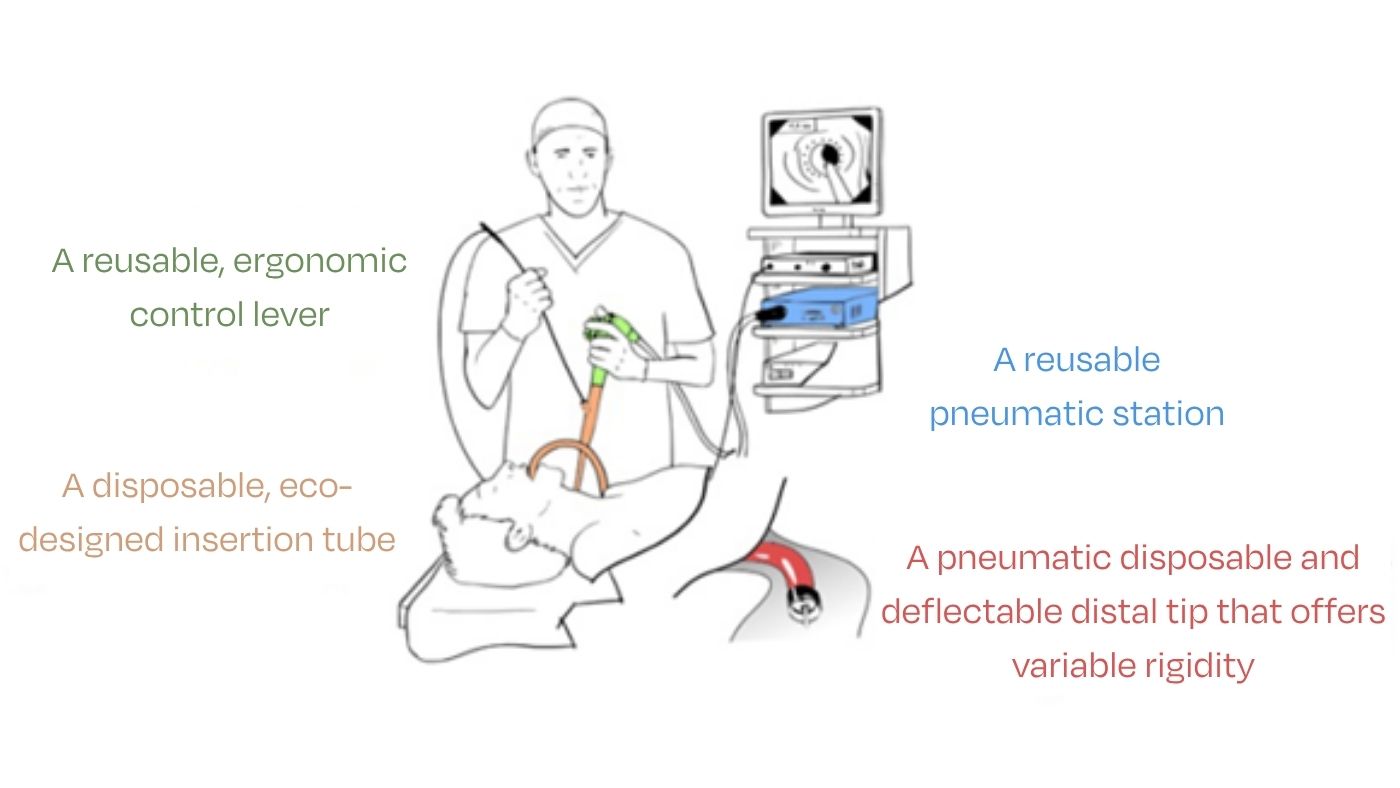
The main aim of the project is to develop an eco-designed endoscope with pneumatic actuation and variable rigidity (using granular jamming). To achieve this, three sub-objectives have been defined:
- Design a functional prototype that achieves TRL 5 technological maturity by the end of the project;
- Develop a life cycle analysis (LCA) methodology specific to endoscopy, in order to guide eco-design choices;
- Develop a circular ‘Product as a Service’ business model, combining a reusable station and a reconditioned disposable tube.
Key results:
- A working prototype of a pneumatic endoscope;
- Comparative LCA data (conventional endoscopes vs eco-designed models);
- Technical specifications for the development of the final device.
Approach
The project is structured around four main axes:
- Axis 1: Quantify
Carrying out life cycle analyses on current endoscopes (reusable and disposable), then applying them to the EcoEndo solution. - Axes 2 & 3: Rethink
Design and prototyping of an endoscope handled by means of pneumatic actuation and variable rigidity. Active collaboration with doctors to integrate clinical needs (flexibility, channels, ergonomics). - Axis 4: Raising awareness
Integration of expectations from the field through a partnership with the Erasme hospital, development of an adapted business model, and awareness-raising actions among stakeholders in the sector.
Target Group
The project is aimed primarily at:
- Technological innovators: developers of minimally invasive medical solutions, experts in flexible robotics and polymers with adaptive properties
- Stakeholders in the medical sector: hospitals, gastroenterology departments, manufacturers of medical devices
Funding
- Type of projet: Belgium Builds Back Circular
- Funding level: 65%
Partners

Our experts

Do you have a question?
Send it to innovation@sirris.be