

OPTICOMP3D | 3D printing of optimised composite structures

A new generation of lightweight structures thanks to non-planar 3D printing
OPTICOMP3D meets a clear need in the industry for manufacturing of lightweight, made-to-measure parts with good mechanical performance. The project uses three powerful technological tools to achieve this: non-planar 3D printing (Freeform), continuous fibre reinforcement and topological optimisation. This approach paves the way for a new generation of composite structures that are robust, economically viable and meet the requirements of cutting-edge technology sectors.
Context
Thermoplastic composites have the advantage of being recyclable, but they require expensive moulds. While 3D printing eliminates the need for these moulds, it is often limited to building up material in a planar way. Topological optimisation is also little used in reinforced printed structures. OPTICOMP3D offers an integrated solution: an inverted printing platform with continuous fibres, controlled by advanced design tools to offer greater design freedom and improved manufacturing efficiency.
Target group
The OPTICOMP3D project is aimed primarily at sectors with stringent requirements in terms of the performance, weight and customisation of components. In particular, it is relevant to the following sectors:
- Aeronautics and space: mass optimisation
- Defence and UAVs: customised robust structures
- Medical and orthopaedics: suitable lightweight devices
- Innovative SMEs: rapid prototyping and small production runs
The project also creates opportunities in sport, design and industrial tooling.
Objectives & results
The main aim of the project is to develop a complete 3D printing solution for composites reinforced with continuous fibres, that is suitable for non-planar geometries with topological optimisation.
More specifically, the project aims to:
- develop a anisotropic topological optimisation software program that is compatible with additive manufacturing (Cenaero)
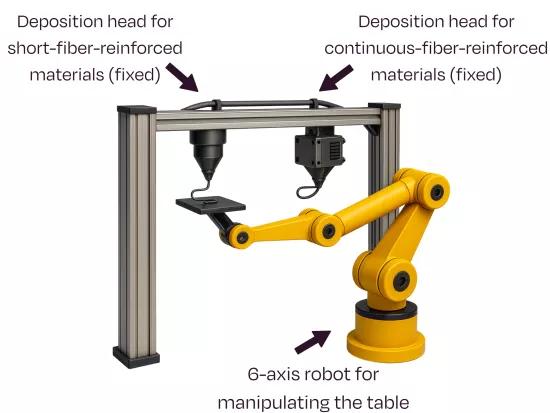
- design an innovative robotic platform combining a moving platform and fixed print heads (Sirris)
- build complex, mechanically validated demonstrators.
The results will be promoted via webinars, scientific publications and industrial workshops.
Approach
The project is structured around eight main work packages (WPs):
- WP1: Definition of the case study - Analysis of industrial needs, choice of demonstrators
- WP2: Software development - Adapting Freeform tools for reverse printing.
- WP3: Hardware platform - Design and manufacture of the printing system
- WP4: Optimisation for support - Simulation and structural lightening
- WP5: Multi-scale optimisation - Anisotropic structures via Morfeo
- WP6: Software and hardware integration - Printing and characterisation of test coupons
- WP7: Study of substrates - Recyclability, removal and dismantlable design
- WP8: Proof-of-concepts - Manufacturing and final mechanical validation
Are you interested in learning more about the OPTICOMP3D project?
Funding
- Funding agency: Win4Collective – SPW Research
- Project type: R&D – CRA – Win4Collective
- Total budget: €599,301.12, grant amount: €449,475.84
Internal link
External link
- Industrial steering committee: Sobelcomp, GDTech, AMOS, Faddtory, FABOT Engineering, Safran Aero Boosters, Spentys
Partners

Our experts


Do you have a question?
Send it to innovation@sirris.be