

PEEK2Space | Hybrid plasma–3D printing for high-performance polymer parts

Development of a hybrid plasma and 3D printing system for high-performance PEEK parts
High-performance polymers such as PEEK are gaining increasing interest in demanding sectors like aerospace, thanks to their lightweight nature and excellent mechanical and chemical stability. The combination of high-performance polymers and additive manufacturing opens up significant opportunities for across industry. However, the performance of printed parts still does not match that of conventional manufacturing processes. The PEEK2Space project aims to develop a concrete solution to improve the quality, reliability and performance of PEEK parts produced by additive manufacturing, through a hybrid process combining 3D printing and plasma treatment.
Target group
The project primarily targets:
- Companies in the aerospace and space sectors
- Industrial companies using high-performance polymers
- Additive manufacturing machine manufacturers
- Engineering companies and R&D centres
- Suppliers of advanced polymer materials
Context
Additive manufacturing of high-performance polymers is evolving rapidly, driven by improvements in equipment and the increasing availability of materials such as PEEK. Machines now offer greater precision, speed and reliability, strengthening industrial interest in these technologies.
Despite these advances, a major challenge remains. Interlayer adhesion is still limited, leading to anisotropic mechanical properties and reduced performance. This structural weakness is a key barrier for critical applications where reliability is essential.
At the same time, industrial needs are evolving. Sectors such as aerospace, space and energy are looking for lighter and more performant high-performing solutions capable of integrating advanced functionalities such as thermal management or electromagnetic shielding.
Objectives & results
To address these challenges, PEEK2Space proposes an innovative approach combining plasma treatment and 3D printing. This combination aims to improve interlayer adhesion during the manufacturing process, thereby enhancing the overall properties of the produced parts.
The project pursues several concrete objectives:
- Improve the overall performance of printed PEEK parts
- Develop PEEK formulations with functional additives
- Optimise additive manufacturing parameters
- Integrate plasma treatment to enhance interlayer adhesion
- Characterise performance improvements
The Sirris – Materia Nova consortium combines complementary expertise. Sirris focuses on materials and processes, while Materia Nova brings expertise in plasma technologies and characterisation.
Key results:
- Enhanced know-how in PEEK compounding
- Increased expertise in additive manufacturing of filled PEEK (process optimisation, improved adhesion via plasma treatment, post-processing)
- Proof of concept of the hybrid process
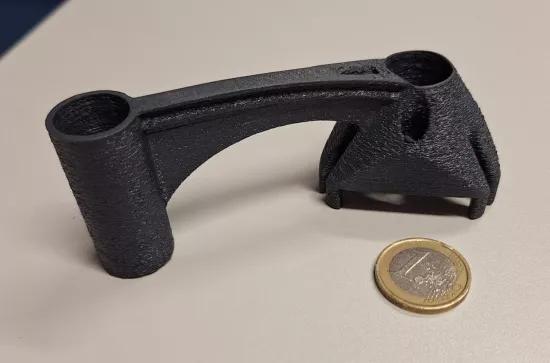
- Demonstrator parts
- Validation of performance (thermal, electrical, shielding)
- Exploitable results (patents, publications, industrial transfer)
Approach
The project follows a structured approach in several steps:
- Optimisation of additive manufacturing parameters for PEEK
- Development of functionalised PEEK formulations using specific additives
- Integration of a plasma torch into the 3D printing process
- Optimisation of plasma treatment to improve interlayer adhesion
- Demonstration of the process at small scale on representative parts
- Techno-economic evaluation and assessment of industrial potential
Funding
- Funding agency: SPW
- Project type: Win4Collective
- Contract number: 2310092
- Total budget: €595,518
- Funding level: 75%
Partners

More information about our expertise
Our experts

Do you have a question?
Send it to innovation@sirris.be