

RECYCOMP | Mechanical recycling chains for thermoplastic composite materials
Promoting a circular economy for thermoplastic composites
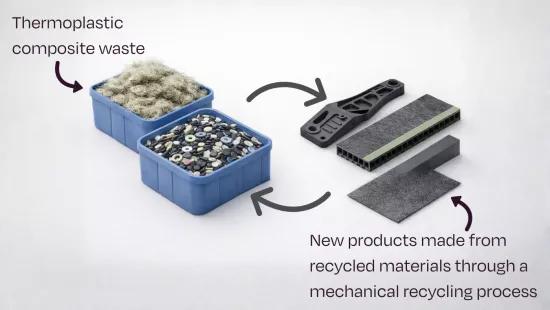
Lightweight, high-performance and easy to process, thermoplastic composites reinforced with long and continuous fibres (CFRTPs) are gaining ground in industry. However, their end-of-life remains a major challenge: due to the lack of structured and accessible high-value recycling routes, a significant share of this material still ends up in low-grade recovery such as co-processing or energy recovery.
RECYCOMP aims to develop practical mechanical recycling processes tailored to the needs of industry and the realities of SMEs, in order to strengthen the circular economy in the composites value chain.
Target group
The project is aimed primarily at companies involved in the use, processing or upcycling of thermoplastic composites. It is particularly relevant for:
- Industries using or producing composites: aeronautics, automotive, defence, sport, health.
- Plastic material processors: injection moulding, extrusion, compression moulding.
- Machine manufacturers: feed hoppers, grinders, specific moulds.
- SMEs: looking to optimise their waste or wishing to incorporate recycled materials.
Context
Despite their intrinsic recyclability, thermoplastic composites are still rarely recovered through material recycling routes that retain their functional and mechanical value. Current solutions are largely linear, while mechanical recycling approaches are not widely adopted or industrialised. In addition, production waste (offcuts) and dry fibre waste represent significant but underutilised resources.
The principal obstacles identified are as follows:
- The lack of comparable technical, economic and environmental data on the various existing recycling processes
- A general lack of knowledge about recycling value chains adapted to thermoplastic composites
- The lack of reproducible, industrialisable and realistic approaches for SMEs
Objectives & results
The main aim of the RECYCOMP project is to develop, test and compare several mechanical recycling chains for thermoplastic composites, including dry fibre waste, in order to promote their recovery and integration into new industrial applications.
More specifically, the project aims to:
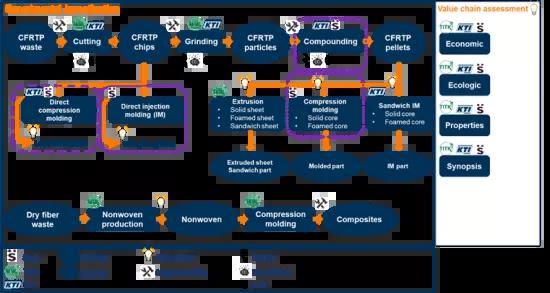
- Develop innovative recycling processes: direct injection of ground material, manufacture of sandwich structures incorporating recycled core layers, nonwovens from DFW.
- Develop a methodology for multi-criteria evaluation (technical, environmental and economic performance) of recycling chains, including life cycle analyses (LCAs).
- Offer a clear and accessible guide to help SMEs choose their recycling strategy.
- Ensure industrial transfer using semi-industrial demonstrators and targeted dissemination actions.
Approach
The project is built around two main pillars: experimental investigations and comparative assessment of recycling chains. Each pillar is structured into several work packages (WPs):
PILLAR 1: Experimental investigations
- WP1: Sourcing, grinding and compounding of composite waste (CFRTPs and DFW).
- WP2: Production and conversion of DFW-based nonwovens.
- WP3: Compression moulding of recycled materials with load-oriented structures.
- WP4: Development of a direct grinder injection process.
- WP5: Extrusion of semi-finished sheets from recycled materials.
PILLAR 2: Evaluating and comparing the value chain
- WP6: Multi-criteria assessment of recycling chains (costs, CO₂ impact, mechanical performance) and summary in the form of a guide for SMEs.
- WP7: Project management and dissemination: Coordination, budget monitoring, sharing of results, demonstrators and seminars.
Are you interested in this project? Contact Didier Garray to find out more
Funding
- Funding agencies: SPW Recherche (Wallonie), CORNET (Allemagne – Thuringe)
- Project type: Cornet – R&D Collective
- Total budget: 828 420,90 €
- Requested subvention (Sirris) : 257 062,95 €
- Industrial Users Committee (Wallonia): Reprocover, HTP Europe, Lessine, BelAlbatros, Plastiservice, Sobelcomp
Internal links
External links
Partners




More information about our expertise
Our experts

Do you have a question?
Send it to innovation@sirris.be