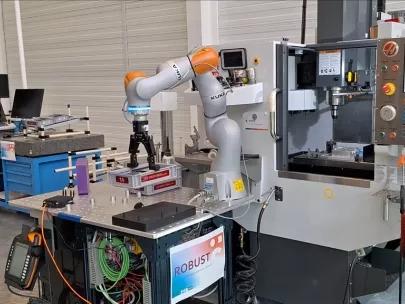
ROBUST | Reconfigurable cOBotic prodUction AsSistanT

A casebook to help you build your own cobot
Discover how Sirris and KU Leuven designed a robust, reconfigurable cobot cart for sheet metal applications. Download the COOCK+ ROBUST casebook for a practical, step-by-step guide to build your own cobot.
Small production runs, large variations, and high uncertainty about the order book make it difficult for suppliers in the metals sector to adopt standardised automation. As a result, the sector still relies heavily on repetitive manual labour, which increases production costs and underutilises technically skilled employees.
Context
The ROBUST project focuses on automating high-mix, low-volume sheet metal processing by using collaborative robots (cobots). Suppliers in this sector face challenges such as small series and varying order profiles. The repetitive manual work is typically of short duration, requiring short automation changeover times. This discourages sheet metal suppliers from adopting standard automation solutions, even when cobots are more user-friendly.
Goal
The main goal of ROBUST is to transform cobots into mobile, reconfigurable production assistants. This involves demonstrating technological building blocks that SMEs can use to deploy cobots in a flexible and mobile way. The COOCK+ ROBUST project supports companies in implementing these automated or semi-automated cobot-based solutions.
Approach
The project addresses the challenges of introducing automation at sheet metal suppliers working with short runs and variable orders. ROBUST focuses on developing solutions that enhance the mobility, reconfigurability, and autonomy of cobots.
These solutions are showcased in four demonstrators featuring different applications, including pressing, welding, deburring, drilling, screwing, sanding, and bonding. The demonstrators cover a wide range of practical setups and constraints. Each is described in detail, and its impact on the production process is measured.
The insights gained from these demonstrators will be shared through publications and a selection guide, helping companies take steps toward automation. This enables them to assemble a mobile production assistant tailored to their specific needs.
Target group
While the project is primarily aimed at sheet metal suppliers, particularly SMEs, it is also relevant to larger companies operating in high-mix, low-volume production environments. These companies often struggle with automation due to variability in orders and small production batches. Examples include firms performing repetitive tasks such as welding, pressing, sanding, and bending.
Funding
- Reference: HBC.2023.0463
Internal links
Partners
More information about our expertise
Our experts



Do you have a question?
Send it to innovation@sirris.be
Combine mobility, reconfigurability and safety in a single automation solution
Within the COOCK+ ROBUST project, Sirris and KU Leuven (ACRO) took on this challenge. The result: a mobile cobot cart that is both highly flexible and compliant with the requirements of an industrial environment.
These technical blogs bring together our insights, and above all, the many practical choices, trade-offs and lessons that can support your own automation projects.
Discover how a mobile cobot cart can make your production smarter