How do you combine mobility, reconfigurability and safety in a single automation solution?
This was the challenge Sirris and KU Leuven (ACRO) took on in the COOCK+ ROBUST-project. The result was a mobile cobot cart that can be put to numerous uses and meets the requirements of an industrial setting.
In this project, we investigated how to design such a cart, position it correctly and integrate it intelligently into your existing production environment. These technical blogs bring together our insights. Above all, they describe numerous practical choices, considerations and lessons learned that will also be useful for your automation project.
Would you like to explore all design choices, technical insights and practical lessons in one complete overview? At the bottom of this article, you can download the full COOCK+ ROBUST casebook.
What can you expect?
- Building a stable and reconfigurable cobot cart
- Always correctly positioned: three alignment methods
- Smart communication with machinery and systems
- Smart cobots thanks to 3D computer vision
- From workbench to mobile cobot assistant: make your production flexible
- Making a mobile cobot plug and play using real-time pose tracking
- Safety when using movable cobot cells: how ROBUST helps companies comply with the regulations
- Smarter programming with cobots: how ROBUST is focusing on programming ease for flexible automation
1. Building a stable and reconfigurable cobot cart
A good cobot cart combines a sturdy frame, suitable wheels and smart connections. You can choose between a welded steel frame (sturdy, less flexible) or an aluminium profile structure (lighter, more adaptable). Think about electrical safety too: maintain strict separation between high- and low-voltage components.
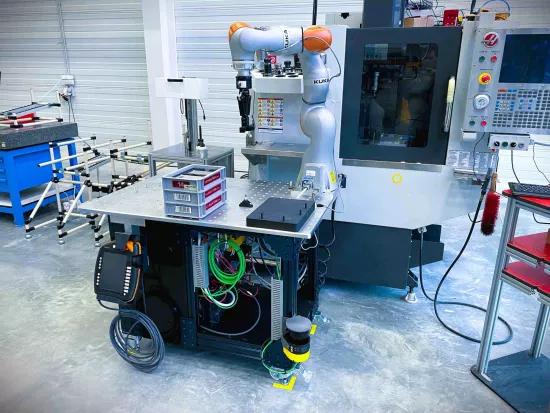
Non-drive wheels are inexpensive and sufficient for limited movement; drive wheels are useful on sloping floors, but require a battery. You should also include a robust worktop, quick-connect connectors, and, with an eye to the future, a valve terminal. In addition, the cobot’s positioning is crucial for its reach and stability.
2. Always correctly positioned: three alignment methods
Correct positioning is essential for precision tasks.
Sirris tested 3 alignment techniques:
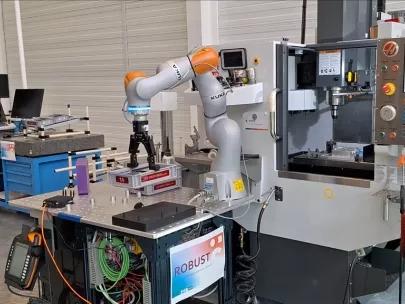
- Physical alignment uses fixed docking points in the floor and cart: fast and precise, but less flexible
- Tactile alignment allows the cobot to detect its own position with sensors: budget-friendly and adaptable, but slower
- Visual alignment with camera markers: extremely flexible, but sensitive to light and less accurate
The demonstration cart combines all 3 techniques, allowing you to choose one or a combination of them to suit the application.
3. Smart communication with machinery and systems
A cobot cart must communicate smoothly with machinery, operators and MES and ERP systems. For crucial signals such as power and safety, use traditional connectors. Location coding ensures that the correct safety zone is activated.
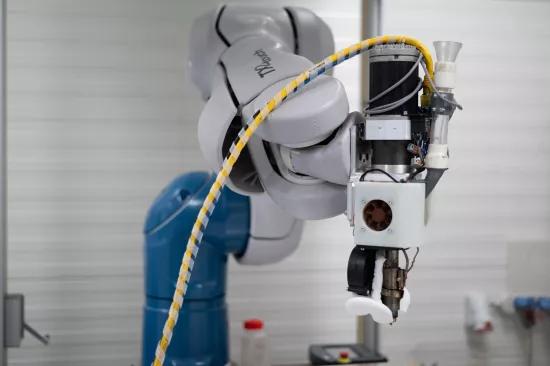
For greater flexibility, Sirris is switching to fieldbus networks and MQTT. A controller translates hardware IOs into MQTT messages, which are shared securely and transparently with the cobot and the MES. RFID scanners and a manual switch ensure extra safety and product tracking.
4. Smarter cobots with 3D computer vision
A cobot sees more with 3D computer vision. This technology enables it to recognize parts by shape and depth and pick them up precisely, even when their position or orientation varies. It makes automation feasible for sheet-metal SMEs with small, changing series.
A cobot equipped with a 3D camera and HALCON vision software detects thin, laser-cut parts on a worktable. The vision system converts that data into movements, allowing the cobot to position and grasp objects autonomously.

5. From workbench to mobile cobot assistant: make your production flexible
Transforming a fixed workstation into a mobile cobot table opens new opportunities for production. With modular wheel systems, a cobot can easily move between stations without fixed setups or major layout changes. This increases both flexibility and cobot utilization on the shop floor.

The motorized wheel modules combine strength, precision and safety. They move heavy loads smoothly, stop automatically when obstacles are detected, and enable quick repositioning. A single cobot can thus handle multiple tasks, from loading and unloading to assembly and finishing.
6. Making a mobile cobot plug and play using real-time pose tracking
A mobile cobot becomes truly flexible when it understands its surroundings. Thanks to 6D pose tracking, the cobot always knows where objects, tools and parts are located in position and orientation. This allows it to grasp and collaborate precisely, even when the workspace or lighting conditions change.
The technology combines camera input and AI to track object motion and orientation in real time. As a result, the cobot can quickly adapt to new situations without complex recalibration or fixed setups. This makes a mobile cobot truly plug-and-play for different tasks and workstations.
Read more about how real-time tracking makes cobots more flexible

7. Safety when using movable cobot cells: how ROBUST helps companies comply with the regulations
A mobile cobot cell offers flexibility, but it also raises strict safety requirements. As soon as you connect a cobot to other machines or move it within your production environment, you become the legal integrator. You are then responsible for the safety of the complete system. With the new European Machinery Regulation, these obligations become clearer and more demanding.
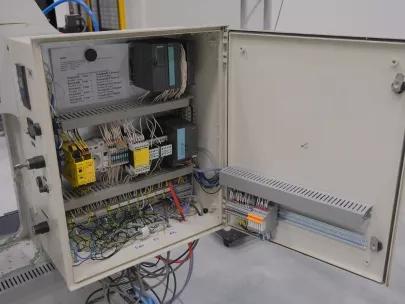
Within the ROBUST project, Sirris and KU Leuven explored how SMEs can deal with this in practice. Realistic risk analyses, reconfigurable safety zones and validated interfaces keep flexible automation workable. This way, you combine mobility with safety, without having to restart a full CE procedure after every redeployment.
8. Smarter programming with cobots: how ROBUST is focusing on programming ease for flexible automation
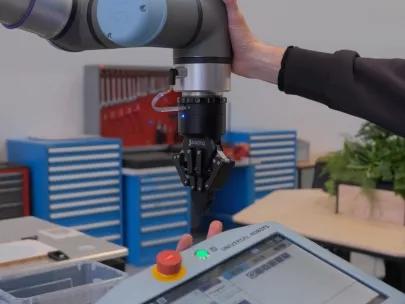
Cobots only become truly cost-effective in a high-mix, low-volume environment when they can be reprogrammed quickly. Classic programming with a teach pendant works for repetitive tasks, but becomes too slow when product changes are frequent. Programming ease is therefore a key lever for flexible automation.
Within ROBUST, several programming approaches were investigated. Teach by Demonstration, offline programming and parametric programs significantly reduce changeover time. AI-driven planning goes one step further and allows cobots to adapt autonomously to variation. This increases both flexibility and return on investment for your cobot application.
A casebook to help you build your own cobot
Discover how Sirris and KU Leuven designed a robust, reconfigurable cobot cart for sheet metal applications. Download the COOCK+ ROBUST casebook for a practical, step-by-step guide to build your own cobot.
ROBUST | Reconfigurable cOBotic prodUction AsSistanT
ROBUST helps sheet metal suppliers with high-mix-low-volume production to automate repetitive tasks using mobile, reconfigurable cobots. Because small batches and changing orders often stand in the way of standard automation, the project uses demonstrators to show how cobots can be flexibly deployed for a variety of tasks such as pressing, welding, deburring, and gluing. ROBUST offers companies practical tools and knowledge to work step by step toward more efficient, (semi-)automated production.
Living Lab Circular Economy Remanumaat (VNS.2023.0113) with financial support from VLAIO.