

How does a cobot cart communicate with its environment?
What does communication mean for a cobot cart?
A cobot cart rarely works in isolation. In most applications, it is part of a broader automated line. It must therefore be able to communicate safely, efficiently and flexibly with machines, sensors, safety components and digital systems such as MES or ERP. So communication plays a crucial role at both the physical and networking levels.
In this blog, we’ll explore how communication is structured in Sirris' demonstrator: from simple connectors to structured fieldbus networks and external couplings.
Discover how Sirris and KU Leuven designed a robust, reconfigurable cobot cart for sheet metal applications. Download the COOCK+ ROBUST casebook for a practical, step-by-step guide to build your own cobot.
Physical communication via connectors
For some signals, a classic connector is still the best choice. This includes:
- Safety signals: these are connected directly to the safety PLC, which means the cobot cart and the fixed machine form a coherent safety system
- Location coding: a physical connection lets the cart know which machine it is linked to. This signal is used to automatically adjust the zone settings of the security scanner to the environment
Limitations? As you add more locations, the cabling and connectors become less flexible. Each additional location requires an additional conductor in the cable, which quickly adds complexity to the system. Moreover, this reduces the reconfigurability of the system.
Smarter communication via fieldbus and MQTT
A network-based solution is a recommended means of reducing the number of cables and making communication scalable.
Here, the Sirris demonstrator operates with a RevPi controller on the machine side. This reads all hardware I/Os locally and converts them to an MQTT connection with the cobot.
Advantages of this approach:
- Thicker and more rigid cable bundles are replaced by a single network cable or wireless connection
- Two-way communication between machine and cobot
- Data is transparently available for MES/ERP
- Security guaranteed via encryption and authentication
- Brand-independent and therefore easily expandable
This creates a communication infrastructure that is not only robust, but also flexible enough for later expansion or integration with other systems.
Manual or automatic: keep it clear
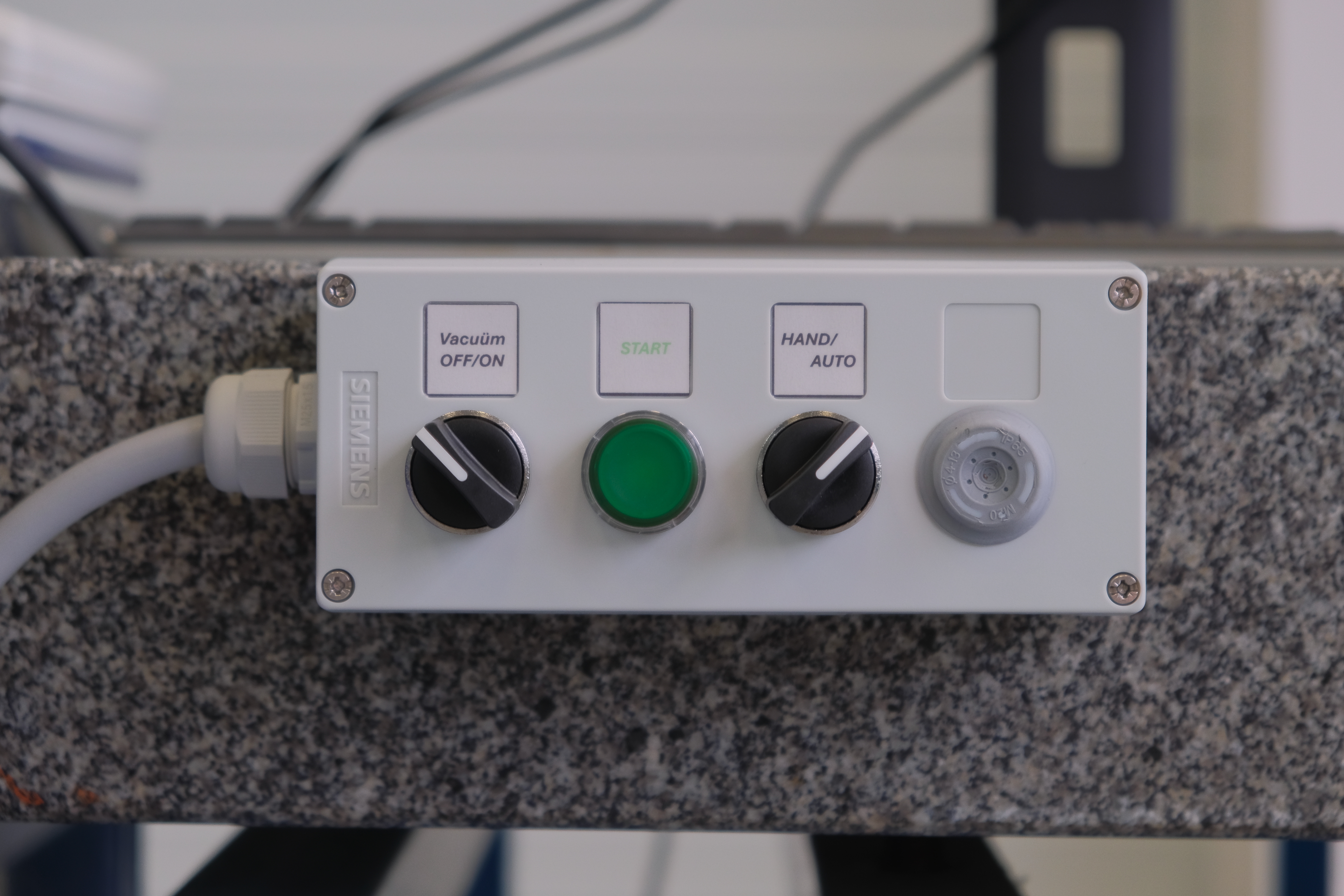
In a modular setup, it is important for operators to know whether the cobot cart is in manual or automatic mode. So a simple switch is provided on each machine the cart can be connected to.
Important principle: a machine may not be operated manually while it is in automatic mode and vice versa. This physical lock helps avoid unsafe situations.
External couplings with MES and ERP
Thanks to intensive communication and sensor use, the entire work process can easily be monitored digitally.
Examples: the RFID sensor on the cart and MQTT communication ensure that the ERP and MES systems know which product the cobot cart is working on. This allows them to automatically update the status of the product. In other words, no need for paperwork.
This digital integration makes it possible to automate the entire work process, without paper work orders, manual checklists or error-prone communication between operators.
Communication driving smart collaboration
A cobot cart is only really valuable if it can work seamlessly with its environment. A smart mix of physical connectors and network-based communication with fieldbus and MQTT opens up new possibilities in terms of flexibility, security and digital integration.
ROBUST | Reconfigurable cOBotic prodUction AsSistanT
ROBUST helps sheet metal suppliers with high-mix-low-volume production to automate repetitive tasks using mobile, reconfigurable cobots. Because small batches and changing orders often stand in the way of standard automation, the project uses demonstrators to show how cobots can be flexibly deployed for a variety of tasks such as pressing, welding, deburring, and gluing. ROBUST offers companies practical tools and knowledge to work step by step toward more efficient, (semi-)automated production.
Discover the other parts of the Cobot cart manual
Part 1: building a cobot cart: sturdy, smart and ready for the workplace
Part 2: how do you ensure perfect alignment of your cobot cart?
Part 4: smart cobots thanks to 3D computer vision
Part 5: from workbench to mobile cobot assistant: make your production flexible
Part 6: making a mobile cobot plug and play using real-time pose tracking
Part 7: safety when using movable cobot cells: how ROBUST helps companies comply with the regulations
Part 8: smarter programming with cobots: how ROBUST is focusing on programming ease for flexible automation


