Align goals and accelerate joint progress
Is co-creation simply collaboration? Not exactly. In co-creation, partners jointly influence both the process and the outcome. You evolve together instead of merely exchanging tasks. This goes beyond a traditional customer-supplier relationship.
For both social enterprises and manufacturing companies, this means you actively align goals, roles and expectations. By aligning goals, you build trust and accelerate the progress of ReX initiatives.
Every social enterprise has its own strengths and context. This framework helps you take the most relevant steps for your situation. We have bundled all insights into one publication.
Download the full publication here
Why aligning goals is crucial
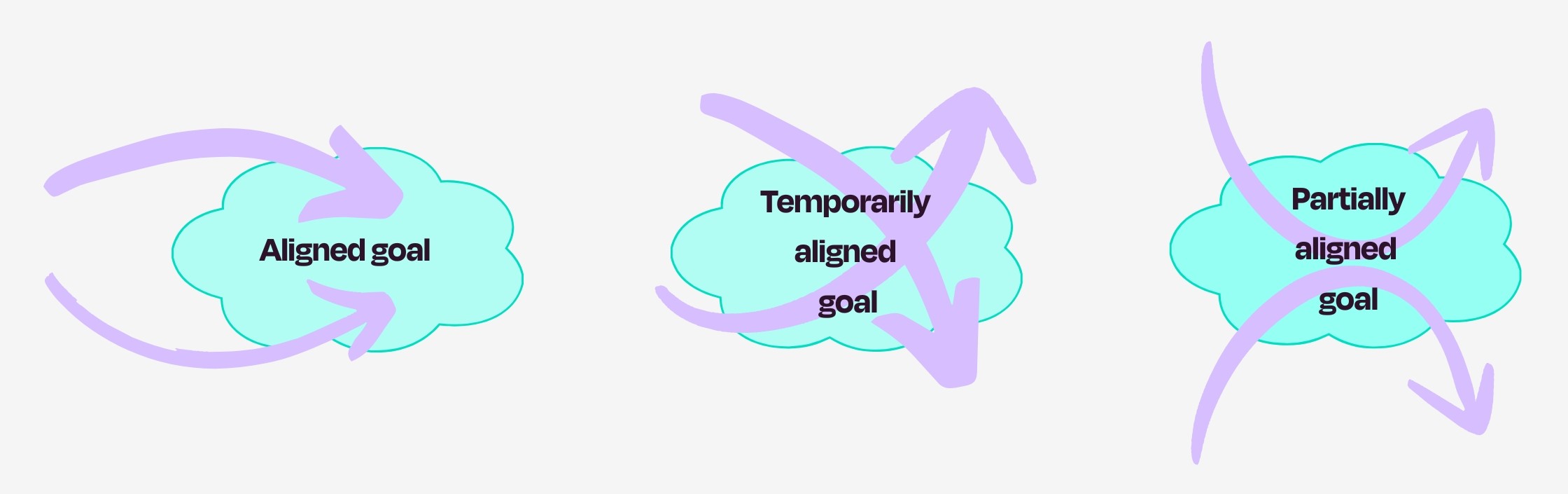
You know where you want to go. Your partner does too. That starting point is rarely identical. By explicitly sharing expectations, room for manoeuvre and boundary conditions, you clarify where overlap exists.
Goals do not need to be identical. They need to be sufficiently aligned in scope, timing or type of activity to enable joint action.
Start fast and learn
Do you see a feasible shared step? Start immediately. Each partner takes responsibility for part of the activities. Each contributes to the costs and effort. Leave room to adjust.
By acting together, mutual understanding grows of each other’s operational, organisational and economic context. This builds momentum and trust.
Roadmap for co-creation
Step 1: explore each other's criteria and uncertainties
Test each other’s success criteria. Work with must-haves, nice-to-haves and no-go’s. Describe your desired situation as a short storyline. This creates recognition and invites feedback.
Ask why and why-not questions. Make risks, assumptions and uncertainties explicit so they can be discussed.
Expect friction. Postpone judgement. Plan a short feedback moment. Take time to reflect and let insights settle. Involve colleagues from different disciplines. Their perspective sharpens next steps.
Practical example
A social enterprise proposes enclave work at a manufacturing company. The production site proves operationally unsuitable. The account manager explores alternatives and identifies opportunities in logistics activities.
Both parties start with a logistics collaboration. They learn about each other’s context and boundary conditions. Later, they jointly explore ReX processes again, this time with greater mutual understanding and trust.
Step 2: build a shared desired situation
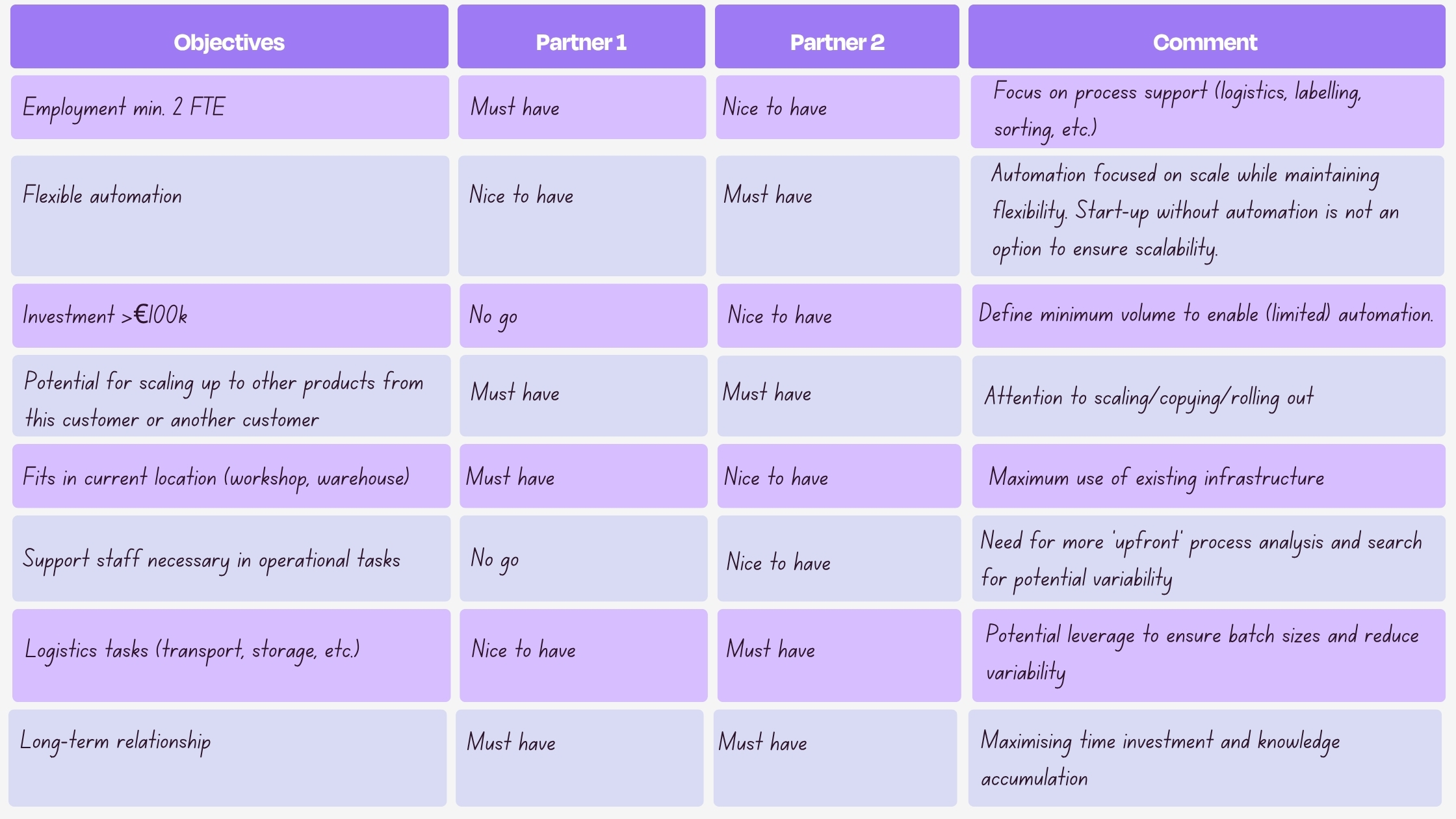
Combine both storylines into one shared vision. Describe the situation as if major bottlenecks have been resolved. Capture only the essential elements and leave details open. This makes the objective concrete and shared without losing flexibility for learning and adjustment.
The combined list of intended results may look like this:
Step 3: reduce uncertainties
Share information, assumptions and risks. Acknowledge each other’s priorities and constraints. Agree on how you inform, question and adjust one another.
Choose a shared workspace and define agreements on access and version control. Plan short and regular alignment moments. Combine physical, digital and phone meetings.
Step 4: define shared priorities
Answer the following three questions:
- Can target group staff handle this activity?
- Can we get this organised practically?
- Is the business case solid?
Select actions that fit within the current room for manoeuvre of both partners. Use a simple prioritisation method and work step by step.
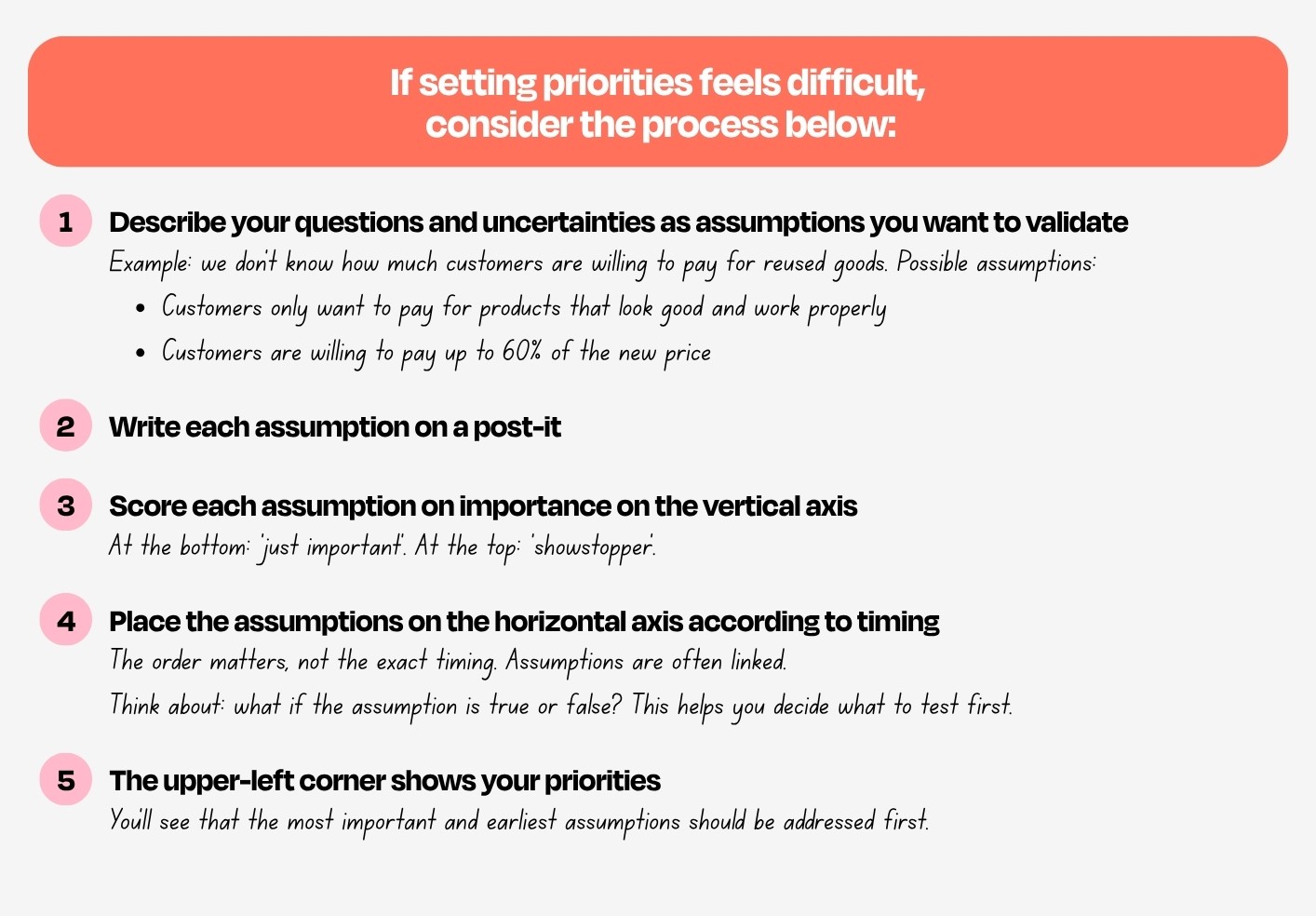
Tip: setting priorities is not always easy. So use this simple method to determine the order of actions together with your partner.
Tips for momentum and trust
- Start small and visible
- Work with short learning loops
- Document and share lessons learnt
- Keep pace of contact light and frequency high
Recommended reading
Win-Win Innovation by Piet Verhoeven and Helga Deschrijver Acco, 2017
Conclusion
By explicitly aligning goals, co-creation becomes a focused approach instead of informal collaboration. You make expectations, uncertainties and priorities discussable. This creates a shared future vision that guides action. Small, feasible steps build trust and accelerate learning. In this way, ReX grows into a structural collaboration with impact for partner, customer and organisation.
Summary
Co-creation is more than collaboration. You align goals, share uncertainties and build a shared narrative. This leads to feasible joint steps that accelerate ReX initiatives and strengthen trust between partners.
A look ahead at the series
In the next article, we further develop the joint business case. We show how you make the numbers work, internally and together with your partner.
Discover the other articles in the ReX series:
- Discover the full ReX series
- Part 1: ReX activities for sheltered workshops: opportunities and collaboration
- Part 2: room for manoeuvre for ReX Initiatives in sheltered workshops
- Part 3: the driving forces for ReX Initiatives
- Part 4: your strengths with regard to ReX initiatives
- Part 5: ReX goals for sheltered workshops
- Part 7: a solid business case for ReX collaboration
- Part 8: one ReX revenue model, multiple business cases
- Part 9: the motivations that drives ReX forward
- Part 10: constraints that make ReX stronger
- Part 11: strengths as a Lever for ReX
Discover the Remanumaat project
Would you like to learn more about this topic and how collaboration within ReX strategies works?
Living Lab Circular Economy Remanumaat (VNS.2023.0113) with financial support from VLAIO.