ReX activities: a challenge for manufacturers
Collecting, inspecting and disassembling products requires time and personnel. Because not all products are designed for reuse, there is a lack of standard procedures. Manufacturers often don’t have the manpower to take a systematic approach in this area, making it difficult to get ReX activities up and running.
Every social enterprise has its own strengths and context. This framework helps you take the most relevant steps for your situation. We have bundled all insights into one publication.
Download the full publication here
Collaboration between manufacturers and sheltered workshops
Sheltered workshops can make a difference here. They are accustomed to handling labour-intensive processes and breaking down complex tasks into manageable steps. Their employees work with precision and efficiency, enabling components that would otherwise go to waste to acquire new value. This creates a win-win situation: manufacturers can maintain their focus on their core production activity, while sheltered workshops create new economic opportunities and additional social employment.
Why ReX collaboration is often difficult
There is still a disconnect between manufacturers and sheltered workshops. Misunderstandings exist regarding each other’s working methods, the speed of processes and expectations. The lack of clear shared goals is often the underlying cause of this. For a successful partnership, a sound business case that convinces both parties is essential. This requires joint exploratory steps, repeated evaluations and the combining of each party’s expertise.
Six building blocks for successful ReX initiatives
Although there is no universal approach to ReX, practice shows that six building blocks form the basis of sustainable collaboration. These fall into two categories: internal and external building blocks.
Internal building blocks for ReX in sheltered workshops
The internal factors are closely linked to the sheltered workshop’s culture. They change slowly, but offer stability and direction.
1. Scope for action: the degree of freedom within the organisation to initiate ReX projects. This determines how much room there is for experimentation.
2. Key people: the people who push projects forward and generate enthusiasm. Their role is crucial in getting colleagues on board.
3. Assets: the strengths an organisation can build on, such as precision work, flexibility or experience in specific sectors.
External building blocks for ReX collaboration
The external factors are about customers, partners and other stakeholders. They are more subject to change, because they respond to market developments and customer demands.
4. Objectives: the ambitions a ReX initiative aims to achieve for a product or process. These provide direction and stability.
5. Co-creation: the process in which partners formulate shared goals and discuss uncertainties. Collaboration here develops through trust and dialogue.
6. Business case: the economic fundamentals that make an initiative profitable for both parties. Without financial support, the partnership will not last.
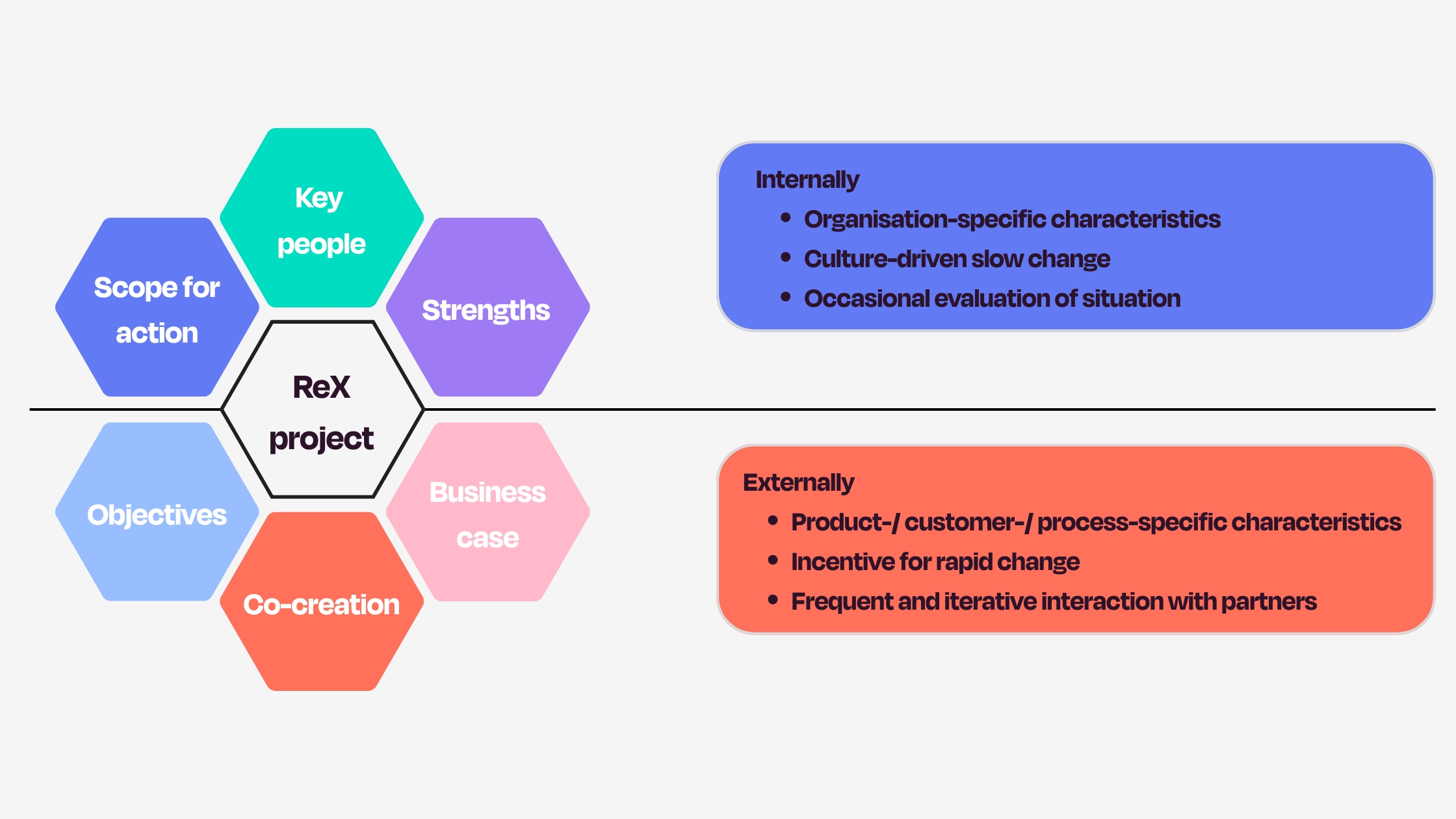
Summary of ReX opportunities for sheltered workshops
ReX activities are demanding, but also present plenty of opportunities. Collaboration between manufacturers and sheltered workshops makes repair and reuse feasible and profitable. Six internal and external building blocks are the key to a successful approach.
A look ahead: six articles on ReX in sheltered workshops
In the following six articles, we will take a close look at each aspect separately. We will explain why it is important, what questions to ask and how to decide on the next steps. With diagrams, examples and templates, we help you make the right choices in your own context. Find out how ReX activities can become a sustainable success in your sheltered workshop too.
Discover the other articles in the ReX series:
- Discover the full ReX series
- Part 2: room for manoeuvre for ReX initiatives in sheltered workshops
- Part 3: the driving forces for ReX Initiatives
- Part 4: your strengths with regard to ReX initiatives
- Part 5: ReX goals for sheltered workshops
- Part 6: co-creation for ReX initiatives
- Part 7: a solid business case for ReX collaboration
- Part 8: one ReX revenue model, multiple business cases
- Part 9: the motivations that drives ReX forward
- Part 10: constraints that make ReX stronger
- Part 11: strengths as a Lever for ReX
Discover the Remanumaat project
Would you like to learn more about this topic and how collaboration within ReX strategies works?
Living Lab Circular Economy Remanumaat (VNS.2023.0113) with financial support from VLAIO.