Why room for manoeuvre is crucial
Do you know how much freedom there is within your organisation to launch ReX initiatives? Awareness of this is often present, but remains implicit, which makes it harder to address or to increase the scope for action.
The freedom to launch ReX projects is determined by many factors: leadership, available resources, organisational structure and corporate culture. Understanding this scope for action and what influences it is the first step towards defining concrete actions together with colleagues or managers.
Complete transparency throughout the organisation is not always achievable. However, when employees involved in ReX initiatives gain a shared understanding of their freedom of movement, a solid foundation for collaboration and action is created.
Every social enterprise has its own strengths and context. This framework helps you take the most relevant steps for your situation. We have bundled all insights into one publication.
Download the full publication here
A step-by-step approach
In this article, we offer a simple approach to identifying this scope for action and working on it together. The process consists of four steps.
Step 1: identify the contributory factors
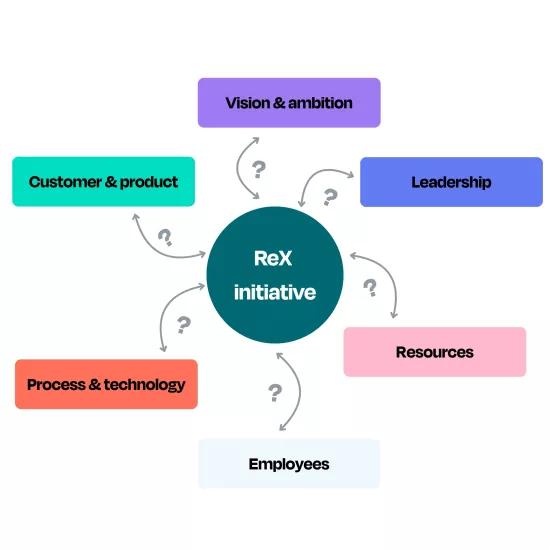
Room for manoeuvre is determined by the interplay between willingness, ability and permission. You want to take action, you have the skills to do so, and you are also given the space to carry out those actions. Previous projects show that the same factors recur:
- The commitment and drive of employees
- The organisation’s ambition and vision in relation to ReX
- The type of leadership
- The available resources
- Processes and technologies
- Customers and their products
Depending on your situation, some factors will have more weight than others. It is worth explicitly identifying these factors and, if necessary, depicting them in visual form.
Step 2: examine the interactions
Next, consider how each factor is relevant to ReX initiatives. This can be done by asking simple cause-and-effect questions:
- Ambition and vision: does the organisation stimulate ReX, or conversely, does an initiative help to formulate vision and ambition more clearly?
- Leadership: does the leadership support ReX, or does an initiative increase the awareness of the leadership?
- Resources: have budgets been allocated, or does an initiative generate new resources?
- Customer and product: does the demand come from customers, or does an initiative open up new customer relationships?
- Processes and technology: are supporting processes already in place, or does an initiative compel innovation to take place?
- Employees: do they have the right skills, or does an initiative mean that better use is made of skills?
You can add to these questions with reflections on change: what triggers innovation, how do new partnerships arise, what investments have been made recently?
Step 3: describe the scope for action
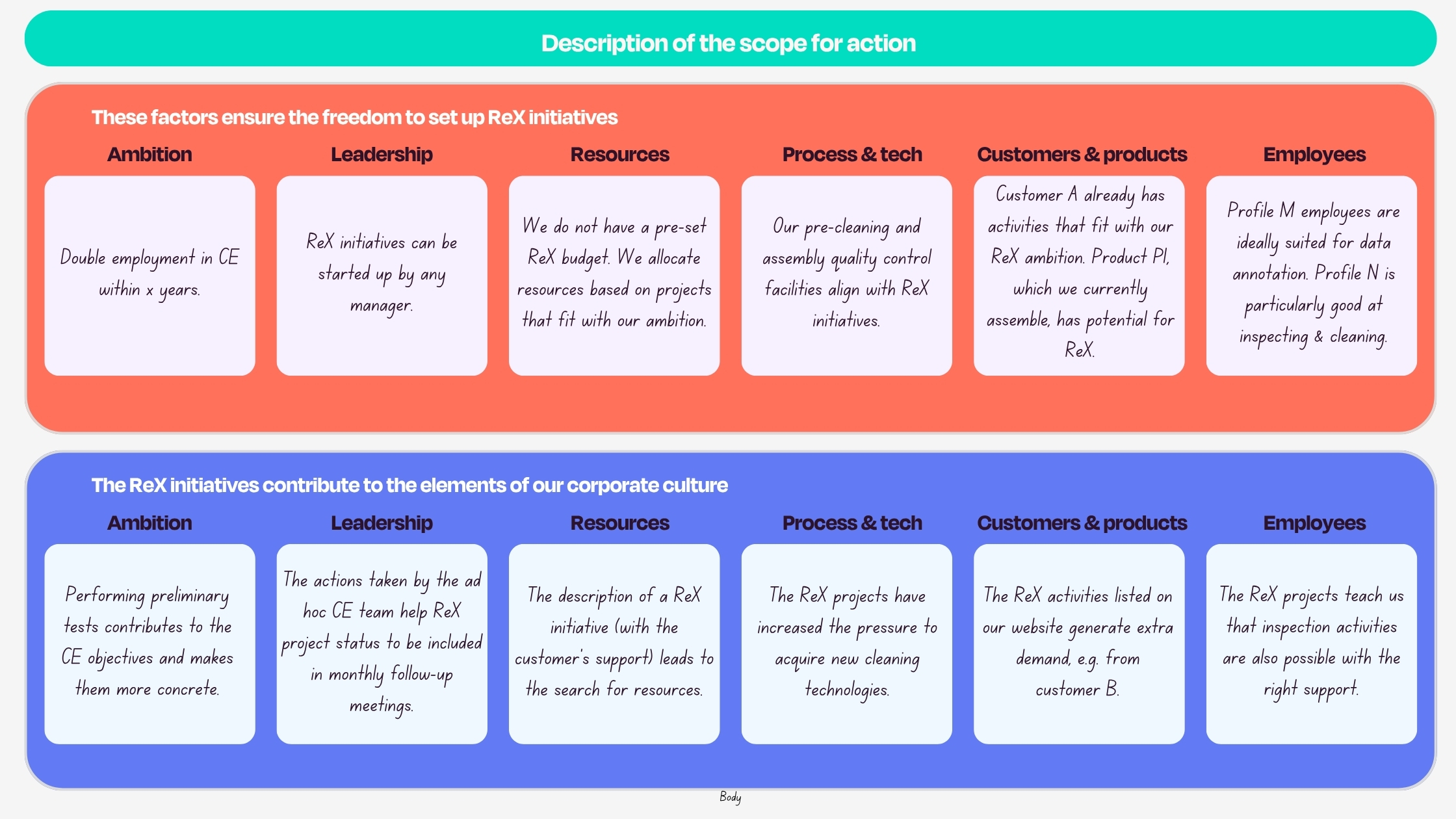
Once these insights have been gathered, you can start describing the scope for action. The goal is not a perfect analysis, but a shared understanding that you can discuss with colleagues.
Focus on facts instead of judgements. Identify what’s already there and where the boundaries lie. This makes discussion possible without resorting to criticism or obstructiveness.
Step 4: determine actions
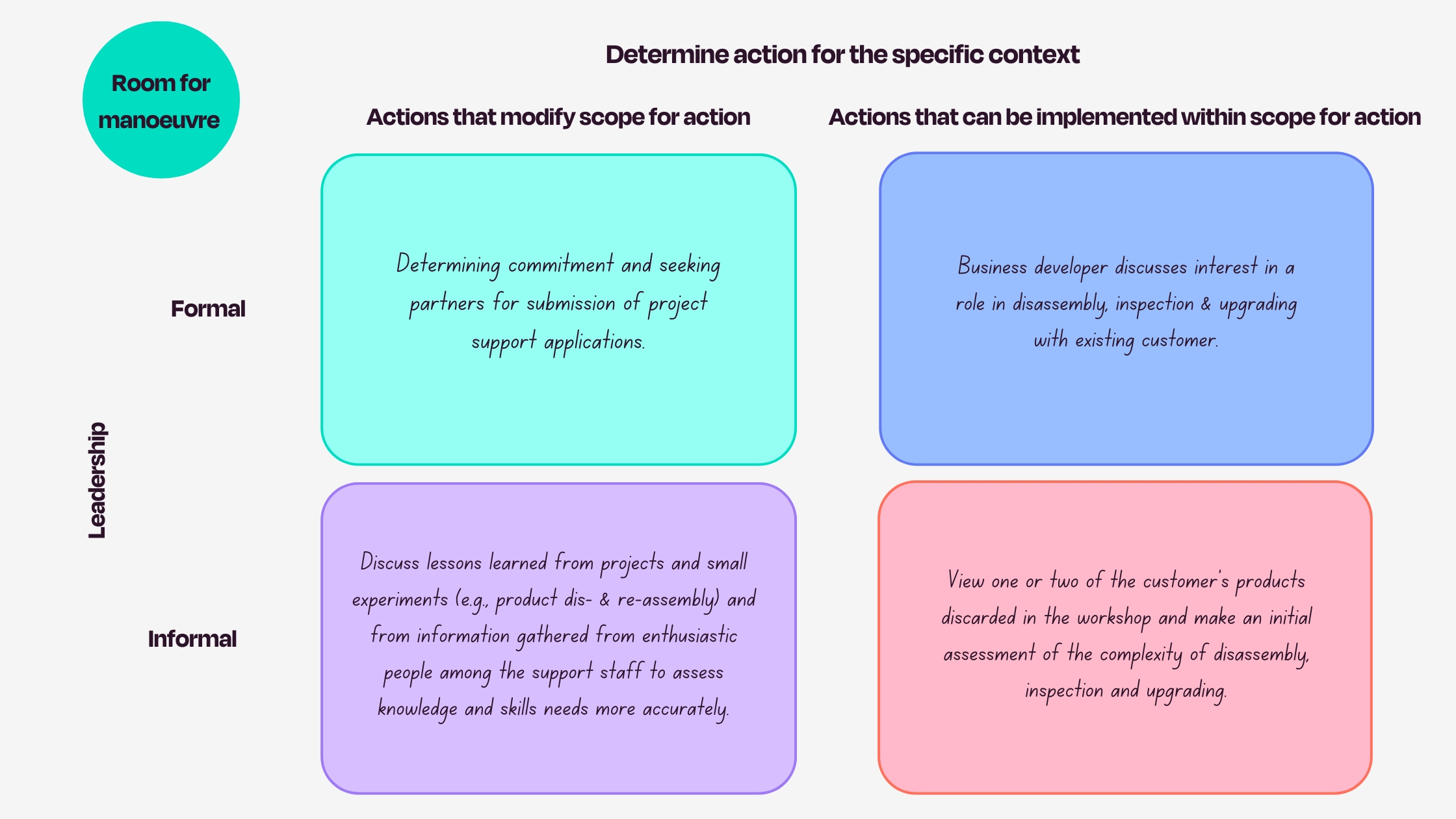
Based on this description, you can formulate actions. Choose actions that fit with the existing scope for action, or those that gradually expand it. Small, informal experiments are often a good starting point. They require few resources but yield valuable insights. If they work, they can be fed back to the formal level.
Recommended reading when scope for action is limited
Sometimes the scope for ReX initiatives turns out to be limited. That need not be a reason to give up. Progress is possible even in such situations. Has this article inspired you? Then be sure to read the books below.
- Making progress where it seems impossible
Read: lock-ins and interdependencies: the chicken or the egg? (Part 1) - Leadership in complex problems
Read: leadership as a success factor in circular projects
Summary
The scope for launching ReX initiatives depends on employees, leadership, resources, processes and customers. By systematically mapping these factors, you can create a shared vision that strengthens cooperation. This allows you to choose feasible actions and gradually increase the scope.
A look ahead at the series
Now that the scope for action has been identified, you can define the next steps accordingly. Working with like-minded people amplifies impact and increases motivation. In the next article, we will look in more depth at the key people in organisations: the people who push ReX projects and make progress possible.
Discover the other articles in the ReX series:
- Discover the full ReX series
- Part 1: ReX activities for sheltered workshops: opportunities and collaboration
- Part 3: the driving forces for ReX Initiatives
- Part 4: your strengths with regard to ReX initiatives
- Part 5: ReX goals for sheltered workshops
- Part 6: co-creation for ReX initiatives
- Part 7: a solid business case for ReX collaboration
- Part 8: one ReX revenue model, multiple business cases
- Part 9: the motivations that drives ReX forward
- Part 10: constraints that make ReX stronger
- Part 11: strengths as a Lever for ReX
Discover the Remanumaat project
Would you like to learn more about this topic and how collaboration within ReX strategies works?
Living Lab Circular Economy Remanumaat (VNS.2023.0113) with financial support from VLAIO.