Identify and capitalise on your existing strengths
Every organisation has strengths that make ReX possible. These are often closely related to your daily operations: assembly usually also means being able to disassemble; people who are good at cleaning can clean more. A strong quality system is just as effective for reassembly. By systematically exploring these strengths, you can identify achievable ReX opportunities that will generate both value and employment.
Every social enterprise has its own strengths and context. This framework helps you take the most relevant steps for your situation. We have bundled all insights into one publication.
Download the full publication here
Making your strengths visible
Why this exercise is worthwhile
- You will more quickly be able to find projects and customers more quickly that align with your ReX activities
- You’ll gain trust, as ReX will be seen as closer to your current operations
- You’ll identify new activities that are both desirable and feasible
Tip: do steps 1 and 2 as a team. This will lend weight to insights, get people energised and accelerate decision-making.
Step 1: discover the nine ReX roles
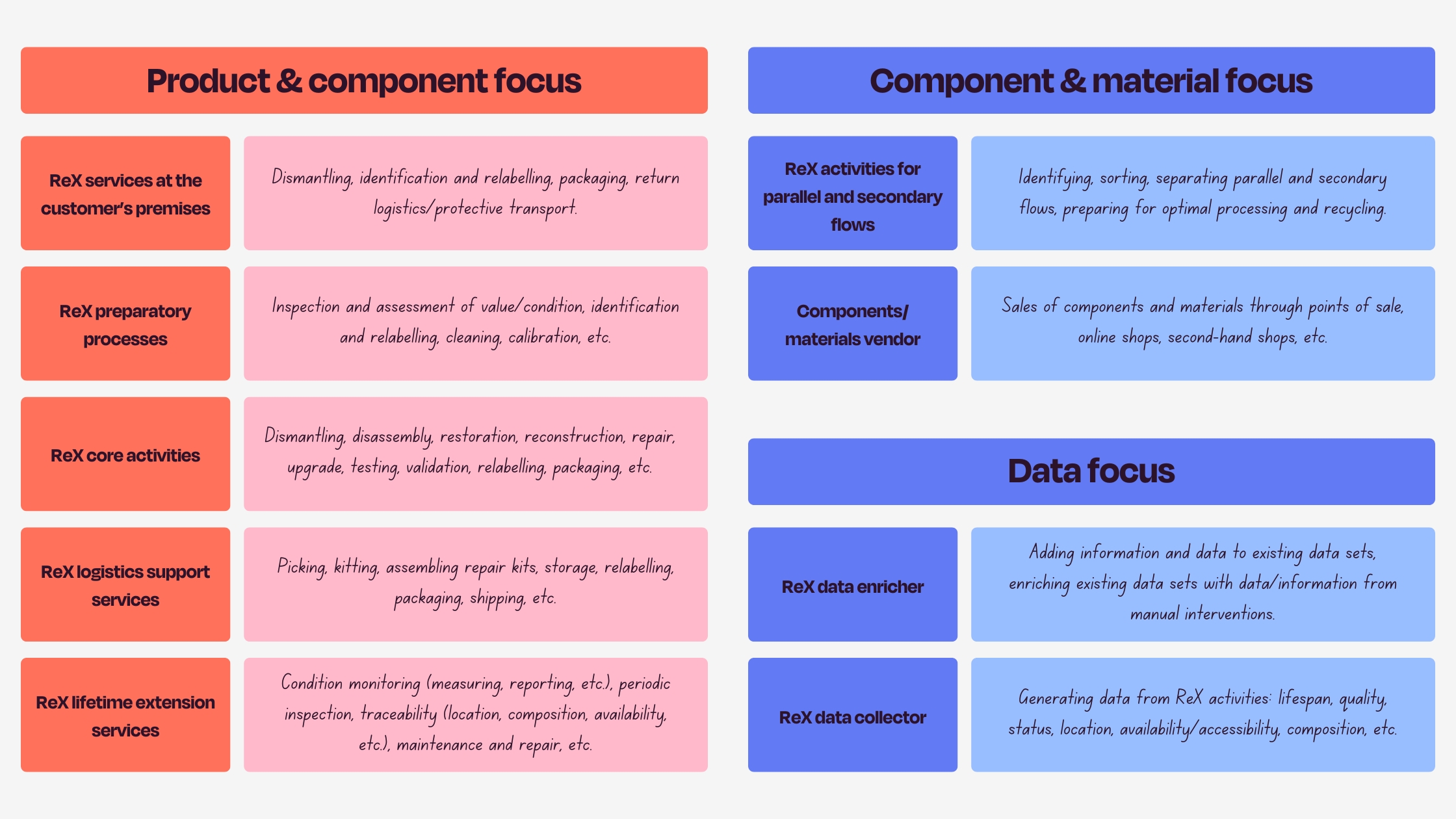
ReX requires numerous concrete actions: dismantling at the customer’s premises, collection and transport, determining residual value and assessing status. Then there are the activities needed to make the product resellable: cleaning, disassembly, repair, reassembly, testing, packaging. Finally, supporting tasks are required, such as assembling repair kits, recording and labelling, updating digital information, reprocessing waste streams and organising sales channels.
Group these activities into nine typical roles. Divide these into three clusters:
- Roles that focus on products and components
- Roles that focus on components and material flows
- Roles that impact data and digitisation
Discuss the roles one by one with the team. This will help you to discover familiar elements and construct a common language.
Step 2: establish the link with projects and customers
Walk around the workplace with these roles in mind. Ask yourself two questions:
- What are we already doing that fits with this role?
- For which recent or ongoing projects and customers is this role meaningful?
Tools such as moulds, visual boards, picking and packaging, storage and quality or data technology often directly support ReX roles.
In many cases, you can make use of what you already have.
Step 3: choose and take action
List all opportunities. Involve intrapreneurs and key people with an external perspective. To start with, go for opportunities with low uncertainty and high potential returns, such as extra employment. If there are none of these, choose low-uncertainty opportunities with lower returns. You want to make visible progress quickly. Small projects teach lessons that can then be applied to bigger opportunities.
Tips & tricks
Use the template to spot opportunities and link actions:
- Focus on projects, products and customers with which you are familiar
- Briefly describe the lifetime-extending activity
- Note what you can do to reduce uncertainty or increase revenue
Discover the ReX roles for sheltered workplaces
Conclusion
Identify your roles, choose accessible opportunities and make them visible. Create a firm basis for what works and use the template to take targeted action. In this way, ReX will grow from isolated ideas into a stable part of your operation.
Summary
Your existing strengths make ReX achievable. By identifying roles, linking them to current projects and deliberately opting for small, safe steps, you will accelerate learning and build trust. ReX will then become a source of both value and jobs.
A look ahead at the series
Now that your strengths are clear, you can adapt your next steps to reflect them. In the next article, we’ll define the objectives of your next ReX initiative and talk in detail about expectations for the customer and partner.
Discover the other articles in the ReX series:
- Discover the full ReX series
- Part 1: ReX activities for sheltered workshops: opportunities and collaboration
- Part 2: room for manoeuvre for ReX Initiatives in sheltered workshops
- Part 3: the driving forces for ReX Initiatives
- Part 5: ReX goals for sheltered workshops
- Part 6: co-creation for ReX initiatives
- Part 7: a solid business case for ReX collaboration
- Part 8: one ReX revenue model, multiple business cases
- Part 9: the motivations that drives ReX forward
- Part 10: constraints that make ReX stronger
- Part 11: strengths as a Lever for ReX
Discover the Remanumaat project
Would you like to learn more about this topic and how collaboration within ReX strategies works?
Living Lab Circular Economy Remanumaat (VNS.2023.0113) with financial support from VLAIO.