How to make customer value and partnership profitable together
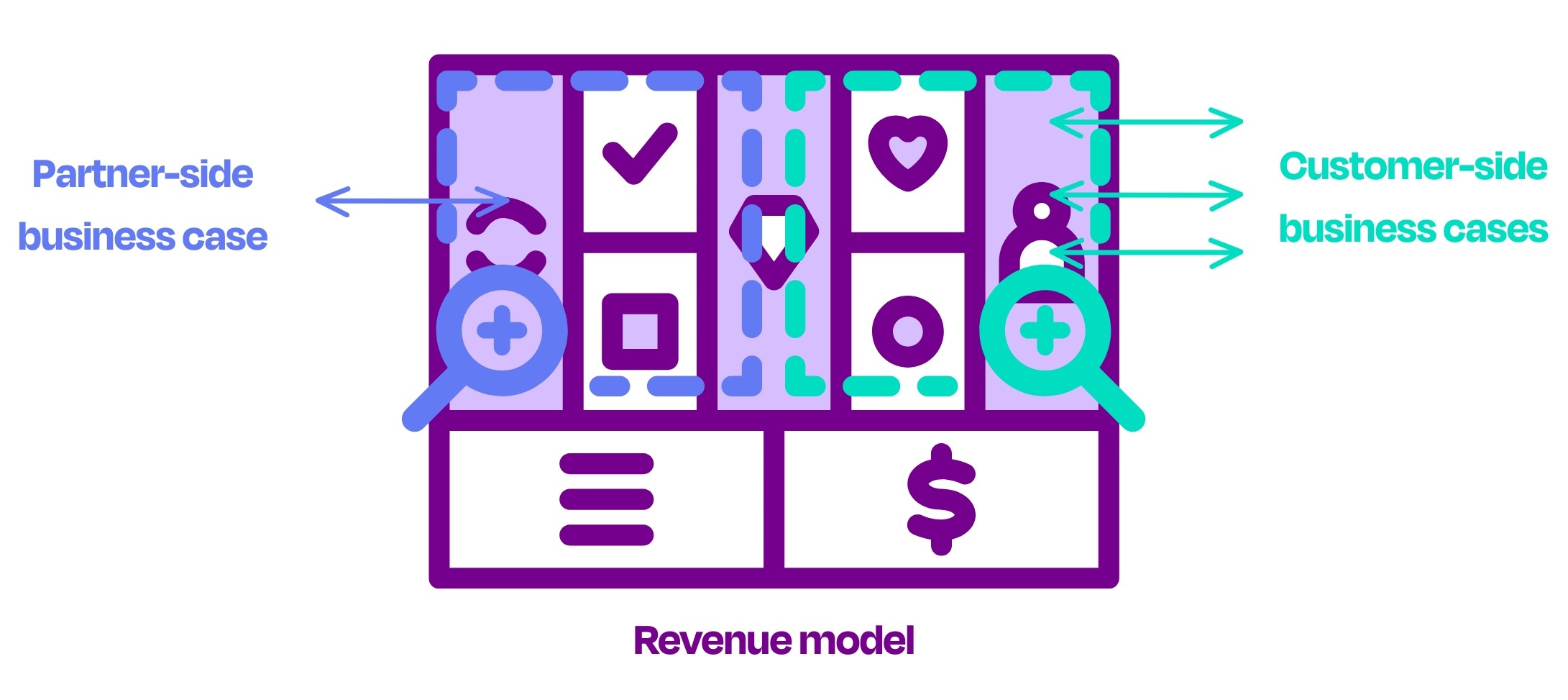
When you are setting up ReX activities, a single business case is rarely enough. You’re working with various products and customers and often with multiple partners. Each of those links has to be right. Only when the business cases on both the customer side and the partner side together form a logical whole will ReX become scalable and financially viable.
A strong ReX earnings model provides solid ground. It helps you make choices, manage expectations and build collaborations purposefully. This way, you avoid fragmented initiatives and build a broadly supported and profitable approach step by step.
Every social enterprise has its own strengths and context. This framework helps you take the most relevant steps for your situation. We have bundled all insights into one publication.
Download the full publication here
Why ReX almost always includes multiple business cases
ReX is all about upgrading products in use or repurposing products after their initial phase of life. This process isn’t confined to a single customer or transaction: multiple customers are often needed to achieve volumes. In addition, partners are needed for logistics, inspection, reprocessing or storage.
Each party involved looks at the whole process from its own perspective. Customers want certainty about cost, performance and delivery time. Partners seek stability, efficiency and clear agreements. Your revenue model needs to bring these interests together.
Your role is to turn those different business cases into one coherent narrative, which must be operationally viable as well as economically sound.
When simplicity is enough
Not every ReX activity is complex. Do you work with your own production equipment, such as machines, moulds or tools? If so, an internal cost-benefit analysis is often enough. You decide to refurbish because it’s cheaper, faster or technically better than replacing.
In this scenario, you are building a single business case with a partner, and the impact on your wider revenue model is limited. Yet here too, ReX can create value, for example through lifespan extension or knowledge accumulation.
Choices that drive your ReX revenue model
Once customers or users are involved, your revenue model is determined by three factors:
- Your product
- Your customer segment
- Your ReX strategy
The chosen strategy, such as repair, reuse, retrofit, refurbish or remanufacture, imposes constraints. It determines what volumes are needed, what processes are crucial and where risks arise.
So make the scope clear quickly. By explicitly choosing certain products, customers and markets, you will be able to tell sooner what ReX activities are feasible and where collaboration becomes necessary.
Step 1: name the value driver for the customer
A ReX revenue model starts with customer value. You need to know why a customer will choose your ReX offer and what they are willing to pay for.
Common value drivers are:
- Maintaining or improving product functionality
- Lower cost compared to a new product
- Shorter delivery time
- Improved availability of products or components
- Outsourcing of non-core activities
- Greater focus on total cost of ownership
- Upcycling end-of-use products
In addition, implicit values often come into play, such as:
- Contributing to CSR or CSRD reporting
- Supporting carbon reduction targets
- Positive impact on corporate image
- Better material flows for recycling
If you recognise these values, you can consciously harness them in the business model and in collaborations.
Step 2: how to present ReX to the customer
ReX can offer you two fundamentally different approaches.
In the first case, the customer retains ownership of the product. You sell a service, such as repair, upgrade or refurbish. This reduces administrative burdens and financial risks. The customer keeps its asset and pays for extra value.
In the second case, you source products from the market. You purchase end-of-life products, take ownership and resell the upgraded product. This opens up new markets and customer segments, but also requires investment in purchasing and storage.
Both models have their opportunities and risks. Your revenue model should consciously take these into account.
Step 3: explore where partners strengthen you
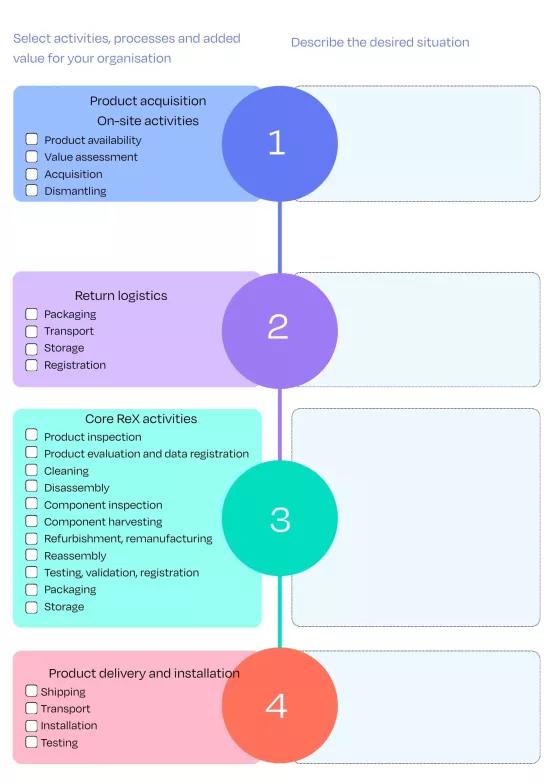
Start from your ReX story and see what steps you can carry out yourself. Use four main stages:
- Acquisition of products
- Return logistics
- ReX core activities
- Delivery and installation
Partners can help reduce risks, increase efficiency or create scale. At this stage, a global overview is enough. Details can be added later.
Step 4: make expectations explicit
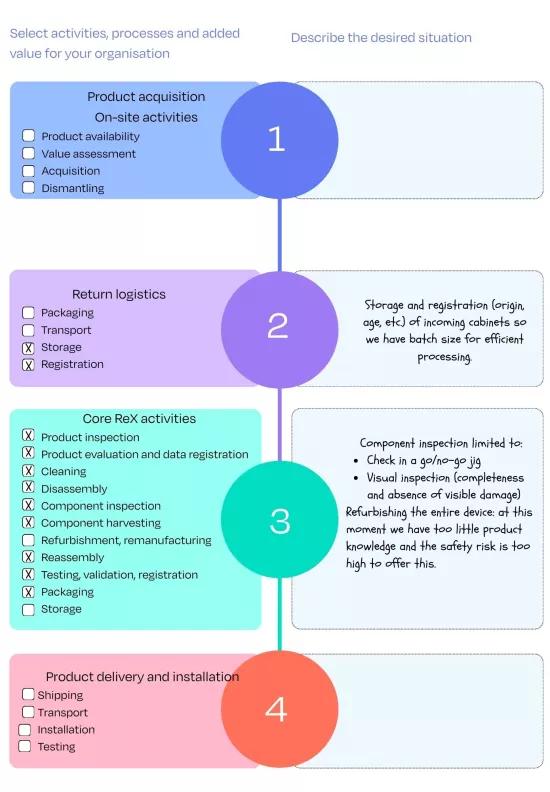
Before engaging with partners, you need to know what you are expecting. Describe your desired outcomes and indicate what:
- Is indispensable
- Is desirable
- Is not up for discussion
This clarity accelerates talks and supports co-creation.
Further reading tips
Conclusion
A ReX revenue model connects multiple business cases. By making choices, making customer value explicit and involving partners with particular goals in mind, you will build a coherent and profitable overall model.
Summary
ReX revenue models become stronger when you explicitly identify how different business cases are connected. By clearly defining customer value, risks and partnership expectations, you provide overview and set direction. You can then build ReX solutions step by step that are not only feasible, but remain scalable and cost-effective.
A look ahead at the series
Discover the other articles in the ReX series:
- Discover the full ReX series
- Part 1: ReX activities for sheltered workshops: opportunities and collaboration
- Part 2: room for manoeuvre for ReX Initiatives in sheltered workshops
- Part 3: the driving forces for ReX Initiatives
- Part 4: your strengths with regard to ReX initiatives
- Part 5: ReX goals for sheltered workshops
- Part 6: co-creation for ReX initiatives
- Part 7: a solid business case for ReX collaboration
- Part 9: the motivations that drives ReX forward
- Part 10: constraints that make ReX stronger
- Part 11: strengths as a Lever for ReX
Discover the Remanumaat project
Would you like to learn more about this topic and how collaboration within ReX strategies works?
Living Lab Circular Economy Remanumaat (VNS.2023.0113) with financial support from VLAIO.